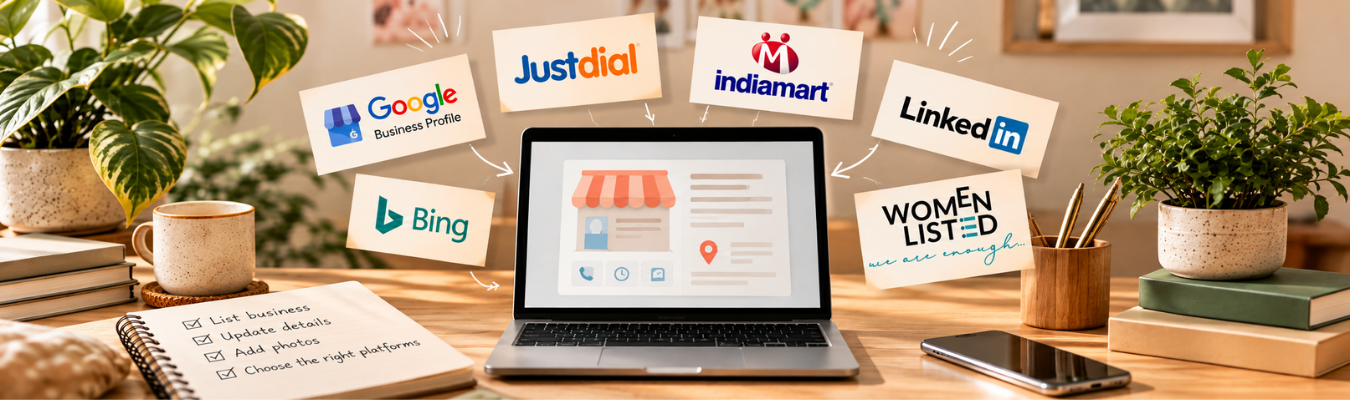
The best place to list a small business in India depends on how customers are likely to look for it. A local salon or caterer needs local search. A manufacturer may need B2B supplier discovery. A consultant benefits from professional credibility. A women-led brand may also want a specialist profile that makes its founder, category and city easier to discover. The goal is not to be everywhere. It is to be listed in the few places that match how buyers actually search.
A listing is useful only when it solves a discovery problem
A business listing is a structured page about a business: its name, category, location or service area, offer, contact details and often photos, reviews or links. It gives a buyer something more stable to search than a disappearing social post. But one listing cannot solve every discovery problem, and no directory can guarantee enquiries, rankings or sales.
That matters for small founders who already rely heavily on Instagram or WhatsApp. Those channels are excellent for conversation and repeat customers, but they are not always the place a stranger starts. A buyer may begin on Google Maps, a B2B marketplace, LinkedIn or a specialist directory before she ever reaches your social page.
1. Google Business Profile: strongest for local discovery — if you are eligible
Google Business Profile is usually the first listing to consider for a business that meets customers in person, has a storefront, or travels to customers within a local service area. It is free and can appear across Google Search and Maps with business information, photos, reviews, hours, products or services and contact actions.
There is an important limitation for home-based and digital businesses. Google says Business Profiles are for businesses that make in-person contact with customers; online-only businesses are not eligible. A home-based makeup artist who visits clients can use a service area and hide her home address. An online-only coach with no in-person customer contact should not create a profile simply because local SEO sounds useful.
Best for: local services, clinics, studios, restaurants, retail shops and service-area businesses that meet or visit customers.
2. Justdial: useful when buyers search Indian local categories
Justdial remains a large Indian local-search directory. Its free listing flow asks businesses for details such as name, address, hours, photos and categories, and the platform is used across service and local-business categories.
It can be worth testing for businesses such as repair services, home services, beauty, healthcare, interiors, coaching, events and other categories where customers actively compare local options. The trade-off is competition: a listing is only useful when the category, city, contact details and service description are accurate enough to help the right customer choose you.
Best for: local service businesses that want another India-specific discovery surface beyond Google.
3. IndiaMART: better for B2B suppliers than for a typical consumer business
IndiaMART is fundamentally a B2B marketplace connecting buyers and suppliers. That makes it more relevant to manufacturers, wholesalers, packaging suppliers, industrial products, bulk sellers and businesses that want trade enquiries than to a consultant or a lifestyle service business.
Best for: B2B product suppliers, manufacturers, wholesalers and bulk-order businesses.
4. LinkedIn Page: strongest when credibility and professional context matter
LinkedIn Pages give a business a searchable company presence on LinkedIn. LinkedIn itself positions Pages as a way for people to find a business, understand its presence and interact with it. For consultancies, agencies, B2B services, trainers, professional firms and founder-led companies, that context can matter more than a general directory.
A LinkedIn Page should not become another empty logo page. Add a clear company description, website, location, specialties and current activity, and make sure the founder’s own profile connects visibly to the business.
Best for: professional services, B2B businesses, agencies, consultants, startups and firms where founder or team credibility influences the buying decision.
5. Bing Places: a useful secondary local listing
Bing Places for Business is a free local-business listing service for Bing. It allows eligible businesses to claim or add a listing, keep details current and verify ownership. It is rarely the first priority for an Indian small business, but it is a sensible secondary local-search step once Google and the main business profiles are in order.
Best for: local businesses that have already completed their primary listings and want broader search coverage.
6. Women Listed: specialist discovery for women-led businesses
Women Listed serves a different purpose from a general local directory or marketplace. It organizes women-led businesses and professionals by category and city, so a buyer can browse for a type of business without already knowing the founder’s name. The listing form asks for structured information including business name, categories, keywords, city, bio, website or Instagram and verification material.
For a woman entrepreneur, the value is not that Women Listed should replace Google, LinkedIn or the business website. It is that a specialist third-party profile can add another searchable context around who runs the business, what it offers and where it operates. That can be particularly useful for home-based brands, independent professionals and small businesses that are otherwise visible mainly inside their own follower network.
Women Listed’s Visibility Ladder makes the same point: a listing works best as part of a wider visibility system, not as the entire system.
Best for: women-led products, services and professional businesses that want niche discovery, an independent profile and category/city visibility.
Should you also list on marketplaces?
Only if the business is ready to transact there. Amazon, ONDC-enabled seller networks and other marketplaces are not simply business directories; they introduce catalog, pricing, fulfillment, fees, returns and platform rules. A founder should not join a marketplace merely to collect another profile. Use it when the channel fits the product economics and customer behavior.
What should every business listing contain?
Before opening six tabs and registering everywhere, prepare one clean information set:
- One consistent business name and founder name.
- The clearest primary category and two or three specific sub-offers.
- A plain-language description of what you sell and who it is for.
- Accurate city, service area or delivery coverage.
- Current phone, email, website and social links.
- Three to five current images that show the work, not only the logo.
- One or two credible proof points: qualification, years of experience, relevant license, client type, media feature or operating capability.
A simple way to choose where to list first
- If customers search “near me” or need a local provider: start with Google Business Profile if eligible, then add another local directory such as Justdial.
- If companies buy your products in bulk: test a B2B marketplace such as IndiaMART and make the supplier information commercial, not decorative.
- If expertise and professional credibility drive the sale: build LinkedIn properly.
- If you are a women-led business and want specialist category and city discovery: create or update your Women Listed profile.
- If you have already completed the main listings: add Bing Places and other secondary profiles only if you can keep them current.
The worst strategy is creating twenty thin listings and abandoning them. Five accurate profiles are more useful than twenty contradictory ones.
Frequently Asked Questions
I already have Instagram. Do I still need business listings? Usually, yes. Instagram is excellent for content and conversation, but listings help people who search by category, location, supplier type or professional need before they know your brand name.
What is the best free business listing site in India? There is no single best option. Google Business Profile is powerful for eligible local businesses, Justdial for Indian local discovery, LinkedIn for professional context, and specialist directories such as Women Listed for niche discovery. The correct mix depends on how customers search.
Can an online-only home business use Google Business Profile? Not simply because it is home-based. Google requires in-person customer contact for Business Profile eligibility. A service-area business that visits or delivers to customers may qualify and can hide its address; a fully online-only business generally does not.
Listing a business online is not a box-ticking exercise. Each platform should earn its place by solving a real discovery problem. Start where customers already search, make the business easy to understand when they find it, and keep the facts consistent across every important profile. For a small business, discoverability usually improves through a connected presence—not through one magical directory and not through being everywhere at once.