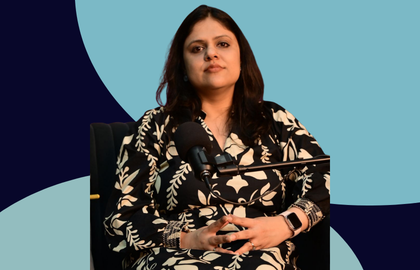
When Sudeep Kaur Kohli thinks about why she built LITWITS, she returns to a much earlier experience: being a young person with 'why' and 'why not' questions that were not always welcomed.
She eventually found the confidence to express those questions, but years later, after stepping away from full-time work during early motherhood and watching her own daughter enter school, the old gap became visible again. Sudeep's background in media, literature and philosophy had taught her to engage with different perspectives; she felt children needed more opportunities to build that habit much earlier.
The first LITWITS sessions began at Bluebells School International in Delhi in February 2016. Ten years later, LITWITS is an education and mentorship platform founded by Sudeep Kaur Kohli, with programs covering critical thinking, writing, debate, public speaking, Model United Nations, research, global competitions, entrepreneurship and academic preparation. Women Listed currently categorises Sudeep under Coaching & Learning, Skills Training, Kids & Parenting and Extracurriculars.
The company has expanded substantially. What is more interesting is what Sudeep has chosen not to change while expanding.
Building From Questions, Not Just Curriculum
LITWITS began with critical-thinking conversations and gradually developed into a wider mentoring ecosystem.
For younger students, the founder describes using storytelling, theatre and book discussions to help children move from instinctive thoughts to structured ideas. As learners progress, programs extend into writing, debating, MUN and public speaking. The current LITWITS program portfolio also includes research, financial literacy, Junior MBA, World Scholar's Cup preparation, SAT and AP preparation, and college counselling.
That could easily have turned LITWITS into a catalogue of courses. Sudeep's stated ambition is broader: to help students learn how to form an argument, question an assumption, communicate disagreement and apply their thinking beyond competitions or classrooms.
Her earliest public account of the business illustrates that emphasis. Reflecting on the first classroom a decade later, she recalled asking a sixth-grade student what he wanted to write about. His response was that he wanted 'sensitive topics' to be discussed more often. For Sudeep, the exchange reinforced that children often have more complex questions than adults assume; what may be missing is an environment in which those questions can be developed constructively.
The Scaling Decision: Staying With Live Mentorship
The most consequential business choice in Sudeep's Women Listed Awards application is not a new course or technology investment.
It is her decision to resist what she calls the 'assembly-line model' of recorded education.
As online learning expanded, pre-recorded content offered an obvious route to serving more students with fewer delivery constraints. LITWITS chose instead to keep live mentorship at the centre of its model, supported by mentor training, feedback and individual interaction.
That creates a harder business to scale. A recorded lesson can serve another hundred students at very little incremental delivery cost; live mentorship requires people, quality control, scheduling and relationships. But Sudeep believes that interaction is precisely where much of the value lies when the objective is critical thinking. A student learning to question, argue or change her mind needs someone responding to the thought process, not simply another piece of content to consume.
LITWITS' current website reports 100,000+ students mentored across 25+ countries, 15+ signature programs and access to more than 50 global competitions. These are company-reported figures rather than independently audited participation numbers, but they indicate the scale at which the business now says it is operating. The LITWITS LinkedIn page independently confirms the organisation's 2016 founding and its focus across debate, writing, MUN, academic preparation and student development.
The commercial challenge now is therefore unusually clear: can a mentorship business become much larger without making the student experience feel more distant?
Learning That Revenue Is Not the Whole Business
Sudeep's own evolution as a founder has involved a second shift.
In her July 2026 Women Listed Awards application, she says that during LITWITS' earlier years, top-line revenue felt like the clearest marker of progress. Over time, she came to see that revenue growth did not necessarily equal a healthy business. Profitability, efficiency, financial understanding and the cost of scaling became more important measures.
She describes that lesson as moving towards thoughtful scale rather than rapid expansion.
The distinction is particularly relevant for a business that has intentionally chosen a people-intensive delivery model. More students require more mentors; more mentors require training, coordination and feedback systems. The company therefore cannot judge growth only by enrolments.
In the same Awards application, LITWITS describes itself as bootstrapped and profitable, with annual revenue between Rs 50 lakh and Rs 1 crore and growth of 25-100% over the previous year. These figures are founder-reported, but they add a business dimension that is often missing from education-founder stories: the mission still has to function as an economically sustainable organisation.
Sudeep puts the internal principle more simply: the bigger LITWITS gets, the closer it needs to look at the individual student experience.
Taking Critical Thinking Beyond Enrolled Students
LITWITS has also taken its approach into larger education initiatives.
The company says it worked with student entrepreneurs through the Delhi Government's Business Blasters initiative, training young people around entrepreneurial thinking and communication. Business Blasters is the practical seed-money component of Delhi's Entrepreneurship Mindset Curriculum, designed to give school students real-world experience in developing and testing business ideas.
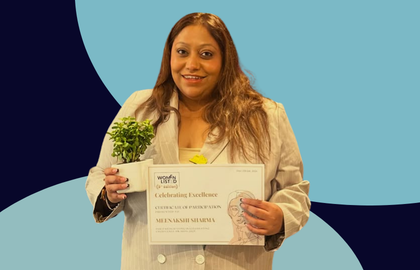
Sudeep and LITWITS also publicly report that she was recognised as Coach of the Year at a World Scholar's Cup Global Round in 2025, a milestone she has linked to the wider work of preparing students for debating, writing and global academic competitions.
Yet competition results are only one part of the proposition. Women Listed's June Business Lounge recap described LITWITS around helping students build sharper thinking, stronger communication and the courage to express themselves - skills intended to compound long after the classroom.
That emphasis helps explain why Sudeep continues to defend a human-led model even as AI makes information and educational content easier to access.
Scaling Attention, Not Just Content
LITWITS' next three-year plan, as shared with Women Listed, includes a wider national and international presence, partnerships with private and government schools, and an expanded CSR-backed scholarship program for students who may not otherwise have access to such training.
Those ambitions will test the central contradiction in the business.
LITWITS wants scale, but it has chosen a model in which personal attention remains expensive and operationally demanding. Sudeep's challenge is therefore not simply reaching more learners; it is creating enough structure around mentors, feedback and delivery that growth does not erase the quality that made live mentorship worth preserving.
For education entrepreneurs, that is a more useful lesson than the familiar story of taking a course online and expanding its audience. Technology can make content infinitely distributable. It does not automatically make good questioning, thoughtful disagreement or mentorship infinitely scalable.
Sudeep Kaur Kohli has spent a decade building LITWITS around the belief that students need space to think before they need another answer. The next stage of the company will depend on whether it can extend that space to many more students while still making each one feel heard.