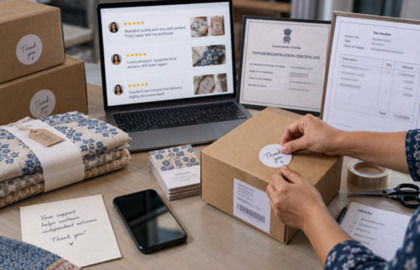
For many small business owners, GST does not become a concern on the day they start selling. It usually enters the picture later - when orders increase, a corporate client asks for a GST invoice, products are sold through an online marketplace, or customers begin ordering from other states.
That is when a seemingly simple question - ‘Do I need GST registration?’ - can become surprisingly difficult to answer. Turnover matters, but it is not the only factor. What the business sells, where its customers are located, how it receives orders and whether it uses an e-commerce platform can all affect the answer.
This guide explains the GST rules most relevant to small and home-based businesses in India, including registration thresholds, interstate and e-commerce sales, the composition scheme, home-address registration and the responsibilities that begin after a GSTIN is issued.
GST registration threshold: the quick answer
For most service businesses, the normal registration threshold is ₹20 lakh in annual aggregate turnover, with ₹10 lakh applying in Manipur, Mizoram, Nagaland and Tripura. Eligible businesses dealing exclusively in goods may use the higher ₹40 lakh threshold in states and Union Territories that adopted it, subject to conditions.
| Business situation | Practical starting point |
| Services such as consulting, coaching or design | Usually ₹20 lakh; ₹10 lakh in Manipur, Mizoram, Nagaland and Tripura |
| Eligible business supplying only goods where higher limit applies | Up to ₹40 lakh, subject to conditions and exclusions |
| Instagram, WhatsApp or own website | Normal threshold and supply rules still apply |
| Eligible goods sold through a marketplace within one state | The 2023 enrolment route may allow below-threshold selling without normal GST registration |
| Interstate goods, exports or mixed cases | Review separately; specific rules and exemptions can apply |
GST looks at aggregate turnover under the same PAN across India, not separately at one Instagram page, city or product line. It generally includes taxable supplies, exempt supplies, exports and interstate supplies, while excluding GST itself and inward supplies taxed under reverse charge. The CBIC threshold guidance is useful for the goods-versus-services distinction.
Do I need GST if I sell from home?
Being home-based does not create a special GST exemption, but it does not automatically make registration compulsory either. A home baker selling locally may have a very different GST position from a consultant serving clients nationwide or a product brand using a marketplace.
Start with four questions: are you selling goods, services or both; what is your PAN-based aggregate turnover; are your supplies local, interstate or international; and are orders coming through your own channels or an e-commerce operator?
How customers pay does not change the underlying supply. Cash, UPI, bank transfer, card payments and marketplace settlements should all be part of the records used to assess turnover.
Can I sell on Instagram, WhatsApp or my own website without GST?
Possibly. Instagram, WhatsApp or your own website does not by itself decide whether GST registration is required. The normal threshold, type of supply and place-of-supply rules still apply.
Qualifying service suppliers can make interstate supplies while remaining below the applicable registration threshold, as reflected in CBIC’s registration guidance. Interstate supplies of goods are more restrictive and need a separate check before the business starts shipping widely.
Marketplace selling also has its own rules. Since October 1, 2023, Notification 34/2023-Central Tax allows certain below-threshold sellers of goods to supply through qualifying e-commerce operators without first taking normal GST registration. The route is conditional: the seller must remain below the applicable threshold, make those marketplace supplies only within one state or Union Territory, avoid interstate supply under that route, declare PAN and place-of-business details, and obtain the required enrolment number.
So “Can I sell online without GST?” has no one-word answer. Selling through your own channels, selling through a marketplace and selling across state borders can create different outcomes.
What changed recently for small businesses registering under GST?
From November 1, 2025, an optional simplified route under Rule 14A allows eligible low-risk applicants, including taxpayers who expect monthly output tax liability on B2B supplies not to exceed ₹2.5 lakh, to opt for electronic registration. Aadhaar authentication is mandatory, and the GST Portal registration guide says registration can be granted electronically within three working days after successful authentication.
A second development is still moving through implementation. In October 2026, the 57th GST Council meeting recommended a simplified registration mechanism for small sellers supplying goods through e-commerce operators in states where they do not have a physical presence. The proposed Rule 14B would allow a qualifying seller to declare the e-commerce operator’s warehouse as the principal place of business in that state, subject to conditions.
That could make interstate marketplace expansion easier, but founders should not assume every platform and state workflow is already live. Check the latest GST notification and marketplace process before relying on it.
Should I register voluntarily even if I am below the threshold?
You can. Section 25(3) of the CGST Act allows voluntary registration even when a person is not otherwise required to register. Once registered, the normal obligations of a registered taxpayer follow.
It may be commercially useful when a corporate customer expects a GST tax invoice, the business wants to claim eligible input tax credit, marketplace or procurement onboarding requires a GSTIN, or turnover is likely to cross the threshold soon.
But registration also creates compliance. Compare the business benefit with the ongoing responsibility instead of registering only because someone said “serious businesses need GST.”
Regular GST or composition scheme?
The composition scheme can reduce routine compliance for eligible small businesses. The main turnover ceiling is ₹1.5 crore for eligible goods businesses, reduced to ₹75 lakh in specified states. There is also a separate concessional 6% route for certain eligible service or mixed suppliers with preceding-year turnover up to ₹50 lakh.
The trade-off matters. A composition taxpayer generally issues a bill of supply rather than a tax invoice, cannot collect GST separately from the customer and cannot claim input tax credit on purchases. Interstate outward supplies remain restricted.
Since 2023, qualifying composition taxpayers can make certain intra-state supplies of goods through e-commerce operators, subject to prescribed conditions, a change reflected in the GST Council’s e-commerce framework.
For a local consumer business, composition may be practical. For a B2B supplier whose customers value input tax credit, or a product brand planning interstate growth, regular GST may fit better.
Can I use my home address for GST registration?
Generally, yes, if you have the right to use the premises and can provide the required proof. The GST registration document checklist accepts documents such as an electricity bill, property-tax receipt, rent or lease agreement and consent letter, depending on the arrangement.
GST registration does not give automatic permission to run every type of business from a residence. Housing-society rules, local permissions, FSSAI requirements and profession-specific regulations may still apply.
What changes after I get a GSTIN?
Registration is the start of a system, not the end of a form. A registered small business needs to issue the correct invoice or bill, maintain sales and purchase records, reconcile bank, UPI, payment-gateway and marketplace settlements, preserve eligible purchase invoices before claiming input tax credit, and file the applicable returns.
Before applying, write down six facts: current and previous-year turnover under the PAN; goods-versus-services split; states from which you operate and sell; sales channels; B2B-versus-B2C mix; and whether your main buyers need input tax credit.
If the answer is still unclear, speak to a practising CA or GST professional. Women Listed’s Finance & Investment directory can help founders discover relevant professionals, while our guide on when business formalisation starts to matter explains how GST fits alongside Udyam and other registrations.
Frequently asked questions
Do I need GST if I sell from home? Not necessarily. Being home-based does not determine GST liability. Turnover, type of supply, customer location and sales channel matter.
Can I sell on Instagram or WhatsApp without GST? Possibly. Social media itself does not trigger registration. Apply the normal turnover and supply rules to the underlying business.
Can I sell on Amazon or another marketplace without GST? Some below-threshold sellers of goods can use the 2023 enrolment route for qualifying intra-state marketplace supplies. Interstate marketplace expansion has additional rules, and the October 2026 simplified registration reform should be checked for current implementation.
Should I take GST voluntarily if a corporate client asks for an invoice? Possibly. Voluntary registration is allowed, but it brings the obligations of a registered taxpayer. Consider buyer requirements, input tax credit, expected growth and compliance cost together.
GST is easier to manage when it is considered before the next stage of growth. Map how the business sells, calculate turnover under the correct PAN, check the sales channel and customer type, and confirm the decision against current rules. The goal is not to collect registrations. It is to know when GST becomes necessary—or commercially useful—and be ready for what follows.