To make a small business more visible online, build more than a social-media presence. A stranger should be able to discover the business by category, problem or location; understand what it offers; find consistent information on more than one credible page; and know how to contact or buy from it. That usually means combining search-friendly business information, relevant listings, reviews or proof, useful content and a clear enquiry path.
First, separate presence from visibility
A business can post every day and still be hard to find. Presence means the business exists online. Visibility means someone who does not already follow the founder can discover it for a need.
Consider three businesses. A home baker may be active on Instagram but invisible for “custom dessert table Noida.” A leadership coach may have a polished website but no page that clearly explains the problem she solves. An interior designer may have strong referrals but an outdated Google profile with the wrong phone number. All three are online. Their discovery systems are weak in different places.
That is why the goal is not “do more marketing.” The goal is to remove the places where discovery breaks.
1. Make the business understandable before trying to make it famous
Start with one sentence that names the offer, customer and relevant location or delivery model. “We create meaningful experiences” is brand language. “Corporate gifting studio in Jaipur offering customized hampers for employee and festive orders” is discoverable business language.
The same clarity should appear in the website title, directory profile, LinkedIn description, Google profile where eligible, catalog or service sheet and social bio. Search systems and people both work better when the core facts agree.
2. Ask whether people can find you without typing your brand name
Brand-name search is useful, but it usually means the customer already knows you. Growth depends on category and problem discovery: “PCOS nutritionist Delhi,” “women-led corporate gifting Gurgaon,” “child therapist online India,” or “handmade ceramic planters Pune.”
Run a simple test in an incognito browser or ask someone outside your immediate network to search for the category. Do not obsess over one ranking. Look for the larger gap: does the business have any relevant page that could reasonably answer the query?
3. Build at least one structured profile outside social media
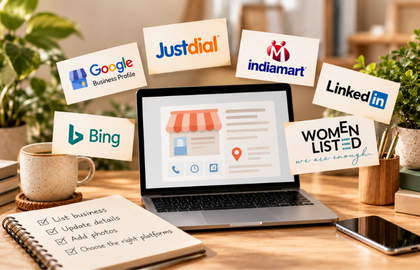
Social platforms are feed-led. Structured profiles are easier to search, compare and revisit. A local business may need Google Business Profile; a professional firm may need a strong LinkedIn Page; a women-led business can add a Women Listed profile so buyers can browse by category and city.
This is not about collecting backlinks or creating dozens of thin directory pages. It is about giving the business credible, consistent surfaces that answer the buyer’s first questions.
If the profile itself needs work, use the Women Listed Visibility Ladder as a separate audit for completeness, proof and trust. The wider visibility question here is whether enough discovery paths lead to that profile in the first place.
4. Use local search only when the business is actually local
Google Business Profile is valuable for storefront and service-area businesses that make in-person contact with customers. It is not intended for every online-only brand or consultant. If customers visit you or you travel to them, keep category, hours, phone, website, photos and service area current. If the business is fully online, focus instead on the website, professional profiles, niche listings and useful content.
Reviews are especially useful in local categories because they answer a trust question before the first call. Do not chase generic five-star volume; encourage real customers to describe the service they actually received.
5. Publish answers to the questions customers ask before buying
Small businesses often know far more than their websites reveal. A baker repeatedly explains storage and delivery. A financial advisor answers the same question about fees. A skincare founder explains ingredients and usage. A consultant keeps clarifying what happens in the first session.
Those questions are content opportunities. Build useful pages around real buyer decisions, not only social captions. Google’s current guidance for AI Overviews and AI Mode says there are no special technical requirements for AI search; the same foundations of helpful, reliable, crawlable content still apply. Google’s AI-search guidance specifically emphasizes useful textual information, internal links and accurate business data.
Women Listed’s own AI Search guide for small businesses makes this practical: be specific enough that a search system can understand what the business does, who it serves and where it operates.
6. Add independent proof, not just more self-description
Visibility without trust creates clicks that do not convert. Proof may be reviews, professional credentials, licenses, awards, verified profiles, media coverage, documented client types, before-and-after process evidence where appropriate, or clear product specifications.
The right proof depends on the category. A therapist needs qualifications and scope of practice. A food brand needs relevant licensing and product information. A corporate supplier needs capacity, lead time and commercial clarity. A founder should never borrow proof language from another category simply because it sounds impressive.
7. Make third-party mentions work harder
A founder feature, recommendation article, podcast, award page or partner page should connect back to the business clearly. Make sure the business name, founder name and category are correct and the relevant link works. Independent mentions can help people and search systems connect the entity across the web.
This is one reason a Women Listed recommendation article should not merely praise a founder. The stronger editorial job is to connect founder, business, category, city and offer in language a buyer can understand.
8. Measure whether visibility is becoming useful
Do not measure only followers. If the business has a website, track search impressions, clicks, landing pages and enquiries. If it uses a Google Business Profile, review calls, directions, website visits and search terms. Ask new customers where they found you.
AI discovery is also becoming more measurable. In 2026, Bing introduced an AI Performance report showing citations, cited pages and grounding queries across supported AI experiences. A small business does not need to become an SEO analyst, but the direction is useful: visibility increasingly includes whether your information is clear enough to be retrieved and cited, not only whether a blue link ranks.
A 10-point visibility audit for a small business
- Can a stranger tell what the business does in one sentence?
- Can the business be found by category or problem, not only by brand name?
- Is the city, service area or shipping coverage clear?
- Is there at least one structured profile outside social media?
- If the business is locally eligible, is its Google profile accurate and active?
- Are the same core facts used across website, listings and social profiles?
- Does the website or profile answer the questions customers ask before buying?
- Is there independent proof that reduces uncertainty?
- Are contact and enquiry routes working and obvious?
- Do you know which pages or channels are actually bringing discovery?
Fix the weakest two first. Visibility improves faster when the biggest gaps are closed than when a founder adds another posting schedule to an already fragmented system.
Frequently Asked Questions
My business is on Instagram but new people cannot find it. What should I do? Create at least one searchable business profile outside Instagram, use clear category and location language, answer real customer questions in crawlable text and make sure all major profiles link to the same accurate business information.
Can a home-based business become visible without a large ad budget? Yes. Start with accurate profiles, useful category language, reviews or proof, internal links and content around real buyer questions. Paid advertising can amplify a clear presence, but it should not be the first fix for a business that is still difficult to understand or verify.
How do I improve visibility in AI search? Use the same foundations that support search visibility: clear identity, useful original information, accurate facts, crawlable text, relevant links and current third-party profiles. Google says there is no separate technical requirement for AI Overviews or AI Mode.
Online visibility is not a content-volume contest. A small business becomes easier to discover when its identity is clear, its information is consistent, its expertise is useful, and credible pages outside its own social feed confirm what it does. Build those pieces deliberately. Once strangers can find and understand the business, marketing has something stronger to amplify.