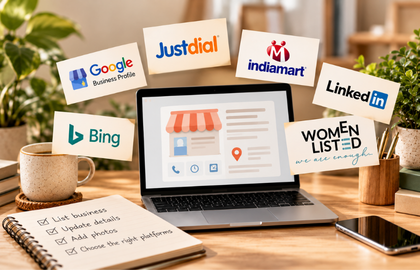
A business can be active on Instagram, participate in exhibitions and receive regular referrals - and still be difficult to find when a new customer searches for it online.
The problem is often not a complete lack of visibility. It is that the business information is scattered. The Instagram page may show the latest work, WhatsApp may carry the product catalog, and an old directory profile may contain incomplete details. A potential customer has to piece everything together before deciding whether the business is relevant and trustworthy.
The Women Listed Visibility Ladder offers a practical way to close these gaps. It explains how a founder can move from simply creating a listing to building a complete, searchable and credible business presence - one stage at a time.
Women Listed’s own search data shows what a strong profile can begin to achieve. In the 12 months ending August 4, 2026, Abhaia Sharma’s profile for Regally Legal generated 2,335 Google impressions and 72 clicks at an average position of 7.9. These figures measure search visibility, not inquiries or revenue. They show that a member page can become a useful search asset rather than remain a profile stored inside a directory.
The visibility ladder: score the business out of 14
Give each level a score from 0 to 2. A score of 0 means it is missing, 1 means it is weak or outdated, and 2 means it is complete and current. The total points to the next improvement the business needs.
| Level | What it establishes | Score 2 when… |
|---|---|---|
| 1. Listed | Presence | Correct identity and contact route |
| 2. Complete | Clarity | Offer, customer, location and next step |
| 3. Categorized | Relevance | Accurate category, city and search language |
| 4. Evidenced | Trust | Credentials, work, policies or outcomes |
| 5. Discoverable | Search footprint | Consistent facts, crawlable links and useful context |
| 6. Featured | Repeated exposure | Media kit and opportunity readiness |
| 7. Referred | Transferable trust | One dependable link and professional follow-through |
Level 1: Listed — create one stable point of presence
The first level is a live profile with the correct business name, founder name, city, category and contact details. It brings together facts that are often scattered across social-media bios, WhatsApp messages, old catalogs and event brochures.
A listing does not replace a website, Google Business Profile or active social channels. It gives them a structured companion and offers potential buyers one page they can search, save and share. Women Listed should strengthen the wider business presence, not attempt to become the entire presence.
Level 2: Complete — answer the buyer’s first questions
A profile can be live without being useful. A complete profile answers the questions a serious buyer is likely to have before making contact:
- a plain-language description of the offer and intended customer;
- specific products or services, not only broad labels;
- city, service area or shipping coverage;
- current images, logo and founder identity;
- working website, social and inquiry links; and
- ordering, booking or response guidance.
Start with three basics: what the business offers, who it serves and where it operates. Women Listed’s guide to writing a business description can help replace vague claims with language customers actually search and understand.
Level 3: Categorized — become relevant to a real search
A customer may search for a nutritionist in Pune, sustainable corporate gifts in Delhi or a home baker in Gurgaon without knowing any founder’s name. The right category, city and customer language help the profile appear relevant to that search.
Choose the most accurate primary category and only the subcategories that genuinely apply. Add location when it affects delivery or service. Use the words customers naturally use, but do not turn the profile into a string of keywords.
Google’s Search Essentials recommends using people’s search language in prominent places and keeping important links crawlable. Accurate categories also make Women Listed’s category pages more useful to buyers comparing businesses.
Level 4: Evidenced — replace claims with reasons to trust
Words such as ‘experienced,’ ‘premium’ and ‘best’ are claims. Evidence gives the customer a reason to believe them.
The most useful proof depends on the business. A practitioner may need qualifications or licenses; a food business may need clear ingredients and compliance; a consultant can show project scope; a sustainable brand can explain materials and process; and a gifting supplier can state lead times and capacity.
Current Women Listed profiles show how specificity builds trust. Abhaia Sharma explains Regally Legal’s focus on making fashion law accessible. CA Isha Bhatia lists GST, income-tax, ROC and compliance services. Vibhuti Jain’s Pigment Lane connects 15 years of textile-design experience with a patented functional-product proposition. These details help a buyer understand the business before making an inquiry.
Level 5: Discoverable — build a connected search footprint
A business becomes easier to discover when the same accurate identity appears across the places customers use. Keep the name, city, website and core description consistent on Women Listed, the brand website, Google Business Profile where eligible and active social channels.
Connect these pages instead of leaving each one isolated. Add the Women Listed profile to the Instagram bio, WhatsApp catalog, email signature, proposal or event QR code. A listing works as a digital business card only when it is easy to reach and kept current.
A founder with a website should keep the business name, URL, logo, address and contact information clear. Google’s Organization structured-data guidance explains how consistent details help search systems identify a business. Its guidance for AI features says the same SEO foundations apply; a separate AI-only file is not required.
SEO helps a page qualify for results, answer-friendly writing makes information easier to extract, and clear details help AI systems identify the business. None guarantees placement. All improve understanding.
Level 6: Featured — earn relevant, repeated exposure
A complete profile with clear evidence gives editorial and event teams enough information to consider the business for suitable stories, interviews, podcasts, awards, sessions or showcases. The opportunity still depends on relevance and readiness.
Prepare a visibility kit before an opportunity arrives: a 50-word description, founder bio, five strong images, logo files, top offers, city, website, proof points and a responsive contact.
Women Listed also creates opportunities beyond listings. The Business Lounge supports founder introductions. The Gift Edit and The Feast connect product businesses with buyers, while the WeEvolve Programme Workshops support learning. The goal is relevant repetition, not appearing everywhere.
Level 7: Referred — make trust easy to transfer
The highest level is not fame. It is easy to refer with confidence.
A referrer should be able to share one link and say, ‘This is the business we discussed.’ The person receiving it should find a current offer, credible proof and a simple next step. The founder then needs to respond, ask the right questions, state timelines clearly and follow through.
An outdated catalog, broken link or unanswered message can weaken that trust. Track profile views, inquiries, qualified conversations and conversions each month, and ask new leads how they found the business.
Diagnose the next visibility move
Add the seven scores. A total of 0-5 means the foundation needs work; 6-10 means the business is visible but inconsistent; and 11-14 means it is ready for wider exposure with quarterly review. Improve the lowest level before adding more activity at the top.
If the offer is unclear, improve the profile. If searchers cannot place the business, fix the category and location. If buyers hesitate, add proof. If the profile sits alone, connect it to the founder’s other channels. If referrals do not turn into conversations, examine the response process.
More exposure cannot repair an unclear offer. More keywords cannot replace trust.
Frequently asked questions
How can a small business increase online visibility?
Create one complete business presence, use accurate category and location terms, add credible proof, keep the facts consistent across platforms and connect the pages with relevant links.
Do business listings help SEO?
A strong listing can give the business another crawlable page, add useful context and support category discovery. It cannot guarantee rankings, and an incomplete or inconsistent listing offers much less value.
What should a founder add to a Women Listed profile first?
Start with a clear offer, accurate category and city, three to five current images, working contact details and one strong proof point.
How often should a business profile be updated?
Review the profile every quarter and whenever the products, service area, links, credentials, availability or contact information change.
How can a business improve visibility in AI search?
Use the same foundations that support normal search visibility: a clear identity, useful original information, direct answers, consistent facts, crawlable pages and relevant links. There is no separate shortcut for AI search.
Visibility grows when presence gains clarity, proof and useful connections. Score the seven levels, improve the weakest one, then list your business or update an existing profile. The goal is to become easier to find, understand and recommend.