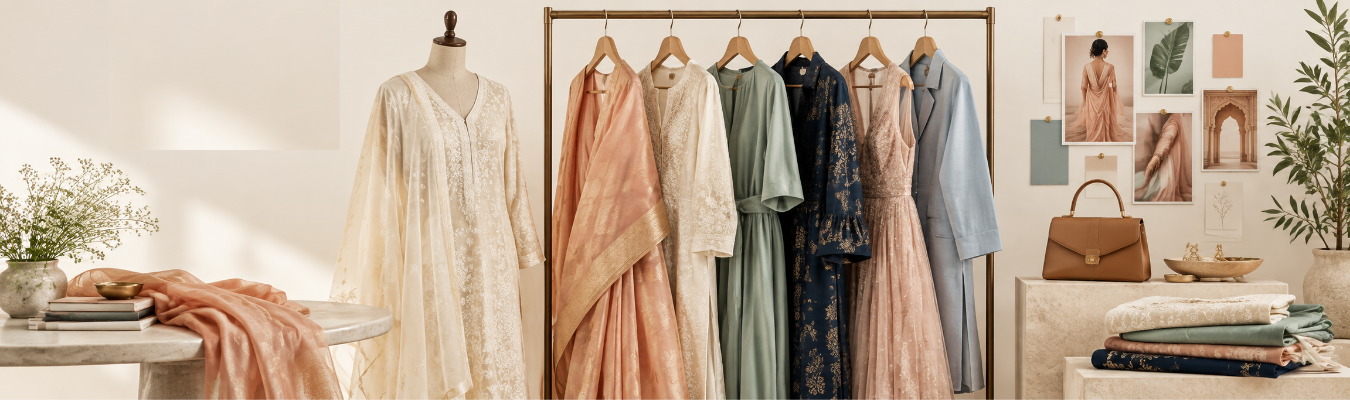
A founder in Bengaluru once told me she started her clothing line with a single sewing machine in her guest room, sketching designs between packing her kids' tiffins. Her story isn't unusual. It's how a lot of women-led brands in India begin, with skill before scale.
If you've ever tried to intentionally shop from women-owned fashion brands in India, you already know the problem. Finding good brands is easy. Determining which are women-founded or women-led is harder, especially when search results are crowded with marketplace pages, listicles, and generic “best brands” roundups.
That gap matters. India's fashion and lifestyle sector is the country's second-largest consumer category at USD 110 billion, with about 10% online sales, according to Bain & Company. For women-led labels, that means digital discovery isn't a side channel anymore. It's central to how brands are built, found, and bought.
This list gets to the point. These are seven women-owned fashion brands in India worth knowing, grouped through a practical buyer lens. Some are established names, some are more mission-led, and one is a smaller discovery through Women Listed. If you're building your own brand, there's inspiration here too. If you're shopping, you'll know where each one fits. For brands thinking about reach, tools like REACH for fashion influencer campaigns also show how much visibility now shapes growth.
Table of Contents
- 1. BIBA
- 2. Suta
- 3. Okhai
- 4. House of Anita Dongre
- 5. House of Masaba
- 6. The Label Life
- 7. Rajasthani Juttis on Women Listed
- 7-Brand Comparison: Women-Owned Indian Fashion Labels
- Your Turn Put Your Rupee Where Your Support Is
1. BIBA

BIBA is one of the easiest starting points if you want a women-founded brand with a long track record. Meena Bindra built the label into a widely recognised ethnicwear name, and that founder story matters because it proves something many small founders underestimate. A sharp product focus, sustained over time, can become a category position.
For shoppers, BIBA is practical. You can usually find kurtas, suit sets, festive pieces, and girlswear without spending ages hunting across ten tabs. The site also makes browsing easier by price, fit, fabric, and occasion, which sounds basic until you've tried shopping festivewear during a busy work week.
Why BIBA works when you need low-risk ethnicwear
The biggest strength here is reliability. If you need everyday ethnicwear, office-friendly sets, or a festival backup that won't feel wildly experimental, BIBA does that job well. The trade-off is that it can feel mass-market if your taste leans indie or highly artisanal.
Buyer note: Not every purchase has to be unique. Sometimes the smarter buy is the one you know you'll actually wear five times.
India's women wear market was valued at USD 13.6 billion in a five-year historical analysis, according to Ken Research. That scale explains why brands like BIBA matter. They sit in a large, competitive category where consistency is a competitive advantage, not a boring one.
- Best for repeat buying: If you already know your rough fit in the brand, reordering for family events or workwear is simpler.
- Best price comfort zone: BIBA is strongest when you want value-led ethnicwear rather than designer experimentation.
- Watch the trade-off: If you want hand-finished craft detail in every piece, this won't always scratch that itch.
- Use it as a benchmark: If you run a fashion business, study how clearly they sort by occasion and budget.
- Read this alongside shopping intent: Women Listed's piece on why you should buy from women-owned brands adds the bigger picture behind purchases like this.
You see a similar clarity in smaller women-led businesses too. Anjali Jain of Eraya is a useful reminder that when a founder knows her lane, customers feel it fast.
For direct browsing, visit BIBA's official website.
2. Suta

Suta feels very different from a classic retail-heavy ethnicwear brand. Founded by sisters Sujata and Taniya Biswas, it built affection through sarees, soft storytelling, and a distinct sense of warmth around the product. That tone isn't fluff. In D2C fashion, brand voice often becomes part of the buying decision.
The catalogue now stretches beyond sarees into blouses, dresses, and separates, but sarees remain the emotional centre. If you're the kind of buyer who wants handloom texture, contemporary styling, and a founder-led narrative that still feels visible, Suta lands well.
Why founder storytelling matters here
Suta works because the founders don't disappear behind the brand. You can feel the personality in the merchandising, drops, styling, and communication. For a woman entrepreneur reading this, that's a useful lesson. People often buy the clarity of the brand before they buy the garment.
There is a real trade-off though. When products are loved for their specific drape, weave, or look, sellouts happen. And with handloom-linked products, slight variation isn't necessarily a flaw. It's part of the product reality.
A brand story only works when the product can carry it. Suta mostly gets that balance right.
India's women's apparel market is projected to grow from USD 28.79 billion in 2023 to USD 45.49 billion by 2032, with urban demand concentrated in metros such as Delhi, Mumbai, Bengaluru, and Chennai, according to Credence Research. Suta makes sense in exactly that urban, design-aware customer pocket.
- Best for saree-first wardrobes: If your closet includes sarees in regular rotation, you'll get more from this brand.
- Best for gifting with meaning: Founder-led and craft-linked brands carry more emotional weight than generic occasion purchases.
- Expect texture variation: Handloom shoppers need a little flexibility. Uniformity isn't the point.
- Move fast on favourites: Popular colours and drapes can disappear quickly.
- Study the product pages: If you sell online, clear visual storytelling is one of the strongest lessons here.
If you're building your own consumer brand and want more practical visibility ideas, Women Listed's guide on business growth for women entrepreneurs is a useful next read.
Browse the collections on Suta's official website.
3. Okhai

Okhai is where you go when the purchase is about more than silhouette. The brand is built around rural women artisans and craft traditions such as mirror work, Rabari embroidery, block print, and chikankari, with support through Tata Chemicals Society for Rural Development. That mission is front and centre, and in this case it adds useful context, not just marketing polish.
What I like here is the product storytelling. Technique filters, artisan notes, and detailed craft cues help the buyer understand why one kurta is different from another. That's a small but important thing. Craft-heavy brands often lose customers because they don't explain the product well enough.
Why craft-first brands need patient buyers
Okhai is strong when you want handcrafted character and you're willing to accept the slower, less standardised side of that choice. Size availability can shift. Some pieces may be limited. Some handmade variation will show up.
That route brings trade-offs too. If you want instant repeatability, marketplace-speed dispatch, and machine-level uniformity, craft-led brands can frustrate you. But if you want your money to go closer to skilled hands, this is exactly the kind of brand worth backing.
One of the clearer gaps in current discovery is that many pages still don't verify whether a label is authentically women-led or merely sells women's clothing. That makes ownership-focused discovery weaker than it should be, as noted in this discussion of the discoverability gap around genuinely women-owned labels in India.
- Best for intentional buys: Buy when you want a piece with visible craft value, not when you're panic-ordering for tomorrow.
- Check sizing carefully: Handcrafted brands often require more attention to measurement charts and stock status.
- Read the product notes: Okhai gives useful technique context. Use it.
- Support the category consciously: If sustainable and artisan-linked fashion matters to you, this is a meaningful lane to shop in.
- Keep exploring similar labels: Women Listed's roundup of women-owned sustainable fashion brands in India is a helpful companion.
Smaller women-led creative businesses are also building trust through story and product detail. Vibhuti Jain of Pigment Lane is a good example of how a distinct point of view helps a brand stand out.
You can explore current pieces on Okhai's official website.
4. House of Anita Dongre

House of Anita Dongre is less a single label and more a fashion universe. Anita Dongre built a portfolio that covers couture and bridal under her name, contemporary western wear through AND, and a younger boho-fusion sensibility through Global Desi. That's why the brand matters for this list. It shows what founder-led scale can look like without collapsing into one aesthetic.
For buyers, this means range. You can look at bridal, festive, workwear, and casual options under related brand umbrellas rather than starting from zero each time your life stage or budget shifts.
Why portfolio brands win across life stages
A founder with multiple labels can meet customers at different points in their lives. That's hard to do well. Many brands either dilute the identity or confuse the shopper. Anita Dongre's portfolio generally avoids that by keeping each line distinct enough.
There's also the craft side. Grassroot and other craft-linked initiatives give the house depth beyond occasionwear glamour. Still, the trade-off is obvious. Prices vary sharply depending on which part of the house you're shopping. AND is not the same decision as couture bridal.
Some brands are worth studying even if you never buy their highest-ticket product. Their architecture teaches you how to scale taste.
For Indian women's wear, the market was valued at Rs 1,18,490.4 crore in 2023 and is forecast to reach Rs 1,66,727.9 crore by 2030 at a 5% CAGR, according to Maximize Market Research. In a market of that size, segmented brand architecture becomes a serious strategic advantage.
- Best for wardrobe progression: If you like staying within one broad design universe across occasions, this works well.
- Know which line you're shopping: Check whether you're in couture, premium ready-to-wear, or a more accessible sub-brand.
- Use stores when fit matters: Occasionwear and event dressing often justify appointments over impulse online buying.
- Watch sale-season stock-outs: Popular sizes move fast in better-known lines.
- Borrow the lesson as a founder: One brand promise can stretch, but only if each sub-line has a clear role.
If you're trying to build that kind of brand clarity in your own business, Women Listed's guide on new market entry strategy is worth your time.
For the full portfolio, see House of Anita Dongre online.
5. House of Masaba

Masaba Gupta built one of the most recognisable visual signatures in Indian fashion. You usually know a House of Masaba piece when you see it. Bold prints, playful motifs, and an unapologetically high-visibility design language are the point.
That matters because a lot of brands stay too safe. They become broadly acceptable and instantly forgettable. Masaba chose the opposite route. It won't work for everyone, but it has made the brand memorable in a crowded category.
Why a strong signature can be the whole strategy
If you're buying for weddings, statement festivewear, or events where you don't want to disappear into a sea of beige, House of Masaba earns its place. The ready-to-ship edits also help shoppers who want occasionwear without the longest couture lead times.
The trade-off is taste. If you're minimalist, the motifs may feel too loud. And while the brand covers different price bands, it still sits firmly above mass-market shopping for many buyers.
A second gap in this space is that coverage of Indian women-led fashion still leans heavily toward legacy names and broad commerce pages, while newer shifts around purpose-led and digital-first labels are less clearly mapped. That discovery gap is visible in this overview of sustainable brands from India, which highlights responsible-fashion visibility without claiming to fully map the women-led segment.
- Best for high-visibility dressing: This is for the buyer who wants the outfit to make a statement.
- Use ready-to-ship smartly: Great for event calendars that don't allow couture-level waiting.
- Check category before budgeting: Pret, festive, and bridal sit in very different spend zones.
- Skip it if you're style-shy: A signature brand only works if you enjoy that signature.
- Study the confidence: Founders often learn too late that being distinct is more useful than being broadly pleasing.
You can browse the current edits at House of Masaba's official website.
6. The Label Life

A lot of women founders do not need another wedding outfit recommendation. They need clothes for investor meetings, team lunches, airport runs, client dinners, and the ordinary Tuesdays where looking sharp still affects how they feel. That is the lane The Label Life serves.
Founded by Preeta Sukhtankar and built with a strong editorial and celebrity-led point of view in its early years, the brand carved out a space between fast fashion and designer labels. That origin matters because the product mix reflects it. You see trend-aware dresses, coordinated separates, accessories, and home pieces designed for women who want polish without building an outfit from scratch.
The appeal is practical. Everyday fashion gets worn enough to justify the spend, especially if your work life shifts between formal and casual settings in the same day. A good pair of trousers or a clean dress often does more work than a one-time statement buy.
The trade-off is clear too. This is contemporary D2C fashion, not luxury construction. Fabrics, fit, and finishing need to be judged item by item, and the strongest buys are usually the pieces with straightforward cuts rather than anything overly fashion-forward.
Repeat purchases in fashion usually come from clothes that solve real weekday problems.
That is why brands like this matter in a roundup of women-owned fashion brands in India. Supporting a women-led business does not only mean buying artisanal occasionwear or heritage craft products. It also means backing women who built for a modern, online-first wardrobe category, where convenience, styling clarity, and fast product discovery shape buying decisions every day.
- Best for urban daily wear: Useful for workdays, casual meetings, dinners, and travel.
- Shop the steady performers: Dresses, trousers, shirts, and matching separates tend to deliver the most wear.
- Be selective on fabric and fit: Read product details and reviews carefully before ordering.
- Use sales with a plan: Discounts help, but popular sizes disappear fast.
- Study the business model: The brand is a good reference point for founders interested in content-led D2C retail.
- Round out the wardrobe thoughtfully: If you are pairing these looks with more handcrafted footwear, this guide to women-led footwear brands where you can find juttis for women is a useful companion.
If you're running a consumer business and thinking about the backend too, Women Listed's article on business management tools is a practical add-on.
Take a look at The Label Life's official website.
7. Rajasthani Juttis on Women Listed

Sometimes the most useful discovery isn't the biggest brand. It's the smaller founder-led business you would never have found if someone hadn't built a better discovery path. That's why Rajasthani Juttis on Women Listed deserves the featured spot here.
The public profile is still light on detail, so this isn't the kind of recommendation where I can tell you exactly which pair to buy. But that's also the point. Many women-led fashion businesses in India are visible in fragments. A WhatsApp catalogue here, an Instagram page there, a stall at an event, a referral from a customer. Discovery is messy. Platforms that organise that visibility are doing real work.
Why smaller founder-led brands deserve a closer look
If you want handcrafted juttis with a regional design identity, a smaller women-led seller can be a better buy than a mass catalogue. You may get more responsive service, possible customisation, and something that doesn't look like everyone else's wedding-season footwear. The trade-off is real too. You might need to message for sizes, confirm materials manually, and wait longer if pieces are made in smaller batches.
That doesn't make the business less credible. It just means the buyer has to behave a little differently. Ask sharper questions. Confirm delivery timelines. Request close-up photos. In return, you often get a product with more personality and a direct line to the founder.
Women Listed is helpful here because it gives founders a searchable profile, image-led discovery, and a more credible digital presence than “DM for details” floating on its own. You can also browse more women-led businesses on Women Listed if you're trying to shop with intention across categories, not just fashion.
- Best for artisanal gifting: Juttis work beautifully for festive gifting, wedding trousseau add-ons, and event favours.
- Ask before paying: Confirm materials, cushioning, sizing, dispatch time, and exchange terms directly.
- Expect small-batch realities: Limited inventory and slower turnaround often come with handcrafted businesses.
- Use the platform advantage: A listed profile gives you a better starting point than an unstructured social page.
- Support with visibility too: Even one tagged story or referral can matter for a founder at this stage.
If juttis are what you're specifically hunting for, Women Listed also has a focused roundup on women-led footwear brands where you can find juttis for women.
A lot of smaller founders grow through consistent visibility, not overnight virality. You can see that same pattern in businesses like Bhavika Agarwal of TheGiftHaus and Sudipta Gupta of For Cookies' Sake!. Different categories, same principle. Clear niche, personal trust, repeat recall.
If you're a founder yourself, this may be the most useful lesson in the whole article. Being discoverable is not a vanity exercise. It's infrastructure.
7-Brand Comparison: Women-Owned Indian Fashion Labels
A useful comparison table should help you buy with intent, not just skim brand names. These seven labels sit at very different points on the spectrum, from scale-driven ethnicwear to small-batch craft and founder-led niche products. For women founders and professionals, that matters. You are not only choosing a style preference, you are choosing which kind of business model gets your money.
| Brand | Founder story and why it matters | Price band | Shopping complexity | Expected outcomes | Ideal use cases | Key advantages |
|---|---|---|---|---|---|---|
| BIBA | Founded by Meena Bindra, who built the brand from home into a national ethnicwear business. It shows what disciplined scale can look like in a category where consistency is hard to maintain. | Budget to mid | Low | Reliable access to ethnicwear across cities and seasons | Everyday kurtas, office ethnicwear, festive buys without much search effort | Wide availability, familiar fits, strong retail presence, frequent offers |
| Suta | Started by sisters Sujata and Taniya Biswas, with a brand voice rooted in fabric, memory, and wearability. The founder story matters because the product still feels personal even as the business has grown. | Affordable to mid | Medium | Strong demand for handloom-led pieces and emotionally resonant wardrobe staples | Sarees, blouses, soft drapes, gifting for someone who values story and texture | Clear founder identity, handloom focus, approachable pricing in many categories |
| Okhai | Built as a social enterprise model connecting artisans, especially rural women, to the market. For readers who care where their rupee lands, this is one of the clearest examples of purchase linked to livelihood. | Affordable to mid | Medium to high | Access to handcrafted pieces with visible craft value and smaller-batch character | Conscious shopping, kurtas, dresses, craft-led gifting | Artisan-led production, strong mission clarity, distinctive handwork |
| House of Anita Dongre | Anita Dongre built a fashion house that spans premium occasionwear, ready-to-wear, and craft-linked labels. The business lesson is scale with design discipline, not scale at the cost of identity. | Mid to luxury | High | Broad wardrobe coverage, stronger service infrastructure, premium design across categories | Bridal, occasionwear, investment pieces, premium ethnic and fusion wardrobes | Multi-label depth, design credibility, stronger omnichannel experience |
| House of Masaba | Masaba Gupta turned a highly recognizable print language into a business with sharp cultural recall. That matters because branding carries real commercial value in a crowded fashion market. | Mid to premium | Medium | Demand for statement pieces that stand out quickly in photos and at events | Weddings, parties, festive edits, bold occasion dressing | Distinctive prints, strong visual identity, ready-to-wear appeal |
| The Label Life | Co-founded by Preeta Sukhtankar, with celebrity-led curation helping shape a polished urban aesthetic. For shoppers, the point is simple: it serves the part of the wardrobe that needs to look put-together without becoming too expensive or too experimental. | Affordable to mid | Low to medium | Demand for polished everyday essentials at accessible prices | Workwear, brunch dressing, city basics, easy wardrobe updates | Wearable styling, accessible pricing, versatile staples, collaborative collections |
| Vedic -Rajasthani_juttis | A smaller founder-led option listed on Women Listed, representing the kind of business many readers say they want to support more often. The trade-off is clear. You may get less standardization, but more personality, craft connection, and customization. | Budget to affordable | Low | Access to traditional juttis with niche appeal, custom possibilities, and limited-run charm | Festive footwear, trousseau add-ons, artisanal gifting, custom orders | Traditional craftsmanship, bespoke options, direct founder visibility |
The main value in this mix is range. If you need reliability, BIBA and The Label Life reduce decision fatigue. If you want your purchase to back artisan networks and slower production, Suta and Okhai make more sense. If the job is occasionwear or identity dressing, Anita Dongre and Masaba serve that role better.
That is also why grouping by category and price helps. It turns support into action. A founder buying weekday kurtas has a different need from someone shopping for a wedding, a team offsite, or a gift that carries more story than logo value.
Your Turn Put Your Rupee Where Your Support Is
A purchase can do two jobs at once. It can solve your wardrobe need today, and it can back the kind of business ecosystem you want around you tomorrow.
That second part matters more than many shoppers admit. Women founders in fashion are building in a crowded market where attention is expensive, repeat trust takes time, and distribution is uneven. A rupee spent with a woman-led brand does more than move inventory. It helps keep design teams employed, artisan relationships active, supplier payments moving, and founder conviction intact.
For readers who are building businesses themselves, that is the core reason this list matters. Supporting these brands is not charity, and it is not abstract sisterhood. It is participation in the same commercial system you want to see work better for women. If more of us say we want founder-led businesses to survive, then buying, recommending, and returning to them is the practical part.
The best approach is simple. Match the brand to the use case, the budget, and the kind of business model you want to reward.
BIBA and The Label Life make sense when the goal is reliability and easy repeat buying. Suta and Okhai are stronger choices when craft, story, and slower production matter more. Anita Dongre and Masaba suit shoppers who want stronger design identity or occasion-led dressing. Rajasthani Juttis is the kind of smaller founder-led discovery that asks a little more attention from the buyer and gives more personality back.
Support works best when it is specific.
There is also a business lesson here. The brands people remember are usually the ones with a clear lane. They know their customer, price accordingly, and make the buying decision easier. That discipline matters whether you are selling sarees, juttis, skincare, or consulting services.
If you want to act on this instead of just agreeing with it, keep it practical:
- Buy one item with intent: Choose based on category and budget, not endless comparison.
- Back one smaller brand publicly: A real recommendation in a WhatsApp group or Instagram story still drives discovery.
- Notice what made you trust the brand: Product photos, pricing clarity, founder story, reviews, or category focus. Use that insight in your own business.
- Check whether your own offer is this clear: A customer should understand what you sell, for whom, and why it is worth paying for in under a minute.
- List your business where discovery is already happening: If you are building too, list your business on Women Listed.
Women Listed gives women-led businesses a place to be found and verified by buyers, collaborators, and other founders. That kind of visibility helps early-stage brands get considered faster, especially in categories where trust decides the sale.
Women Listed is where women entrepreneurs across India get seen, trusted, and found. Explore Women Listed to discover women-led brands, build your profile, and grow inside a community designed for women-led businesses.