A founder in Gurgaon once told me she froze every time someone asked, “So what exactly do you do?” Not because she didn't know her business, but because she had five different answers depending on whether she was talking to a customer, a cousin, or Instagram.
That's the problem with most business descriptions. They're either too vague, too wordy, or stuffed with polished phrases that sound nice but say very little. And when your first impression is happening on a phone screen, that fuzziness costs you.
In India, more than 881 million people were using the internet in 2023, and Google held roughly 96% of the search market, according to DataReportal's India digital report. Your business description is no longer a boring profile line. It's part pitch, part filter, part discovery tool.
If you've been wondering how to write business description copy that helps people understand, trust, and remember your business, this guide will help. You'll get a practical framework, platform-specific examples, keyword tips that don't sound robotic, and before-and-after rewrites you can use this week.
Table of Contents
- Why Your Business Description Is More Than Just Words
- The 6 Key Ingredients of a Powerful Description
- Writing for Different Platforms A Comparison
- Finding Your Keywords Without Sounding Like a Robot
- Editable Templates and Real Before After Examples
- Common Mistakes That Weaken Your Description
- Your Turn Write Your Business Story This Week
Why Your Business Description Is More Than Just Words
A weak business description usually sounds like this: “We provide high-quality solutions suited to your needs.” It could belong to a salon, a CA, a gift brand, a therapist, or a caterer. That's exactly why it fails.
Your description has to do more than “introduce” your business. It needs to help the right person decide, very quickly, whether you are relevant to them.

A good description does three jobs at once
First, it creates a clear first impression. If someone lands on your Instagram bio, Google profile, or directory listing, they should know what you do in seconds. Not after decoding your brand poetry.
Second, it filters for the right customer. A broad line attracts broad confusion. “Handmade wellness products” is loose. “Small-batch soy candles for gifting and home decor” is easier to understand and easier to buy.
Third, it helps you get found. In a market as connected as India, discovery often starts with search. That's why wording matters. The phrase “bridal makeup artist in Jaipur” works harder than “making women feel beautiful.”
Practical rule: If a stranger can't tell what you sell, who it's for, and where you operate, your description is still unfinished.
This matters even more if you're building through digital platforms instead of walk-in traffic or referrals alone. A listing, profile, or business page only works when the words on it are doing real work. That's also why how listing can help women enterpreneurs is not just about being present on a platform. It's about being understandable once someone finds you.
A strong description won't replace your product quality or service delivery. But it does earn you the next click, message, or enquiry. That's the trade-off. You don't need clever writing. You need useful writing.
The 6 Key Ingredients of a Powerful Description
A business description gets easier to write when you stop trying to sound impressive and start building it in parts. Most strong descriptions include the same core ingredients, even when the business itself is very different.

Write the line that makes people get it fast
Start with your headline. This is usually your business name plus a plain-English tag. Not a slogan that needs interpretation. If your brand is Ambrea Image Consultancy, the useful follow-up is something like “image consulting and personal branding for professionals,” not “helping you step into your best self.”
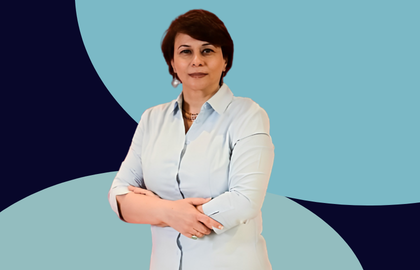
Take Deepra Gagneja of Ambrea Image Consultancy. A service business like hers works best when the description immediately names the service and who benefits from it. Service businesses lose leads when they hide the service behind abstract transformation language.
A practical structure looks like this:
- Headline: Your name or brand plus a direct tag.
- The What: What you offer.
- The Who: Who it's for.
- The Why: Why your version is worth choosing.
- The Proof: A credibility marker.
- The CTA: What the reader should do next.
Here's what that can sound like in everyday situations:
- Headline: “Ambrea Image Consultancy, personal branding and image consulting”
- The What: “Helping professionals improve executive presence, wardrobe strategy, and communication”
- The Who: “For founders, leaders, and working professionals”
- The Why: “Practical, confidence-building guidance designed for real work situations”
- The Proof: “Based in India, offering personalised consulting”
- The CTA: “Book a consultation” or “Message for a discovery call”
The middle of your description is where many founders drift into fluffy language. Don't. Name the offer directly. If you sell festive hampers, say festive hampers. If you run prenatal yoga classes in Chennai, say that. If you provide GST and bookkeeping support for small brands, say that.
A short video can help if you want another simple angle on positioning and messaging:
Good descriptions reduce friction. They answer the customer's first question before she has to ask it.
A few working rules make this much easier:
- Lead with the offer: Put your actual product or service near the front.
- Name the customer: “For new mothers,” “for wedding gifting,” “for small businesses,” all work better than “for everyone.”
- Add one differentiator: Handmade in Jaipur, online across India, customised for corporate teams, vegan formulations, small-batch baking. Pick one that is real.
- Show proof without overselling: Credentials, location, years in business, process, or specialisation all help.
- End with direction: Shop, enquire, book, browse, message. Don't leave people hanging.
If you want a sharper framework for this kind of concise messaging, elevate your pitch with 4 must-have ingredients for unforgettable success is a useful companion read.
Writing for Different Platforms A Comparison
The biggest mistake I see is copy-pasting the same description everywhere. Your Instagram bio, WhatsApp Business profile, Google Business Profile, and directory listing don't do the same job. They sit in different moments of the buyer journey.
One business, different versions
India had 8.05 million women-owned establishments out of 58.5 million total establishments, and women-owned establishments accounted for 13.76% of all establishments in the Sixth Economic Census, according to the Ministry of Statistics and Programme Implementation. In a market that large, a generic introduction disappears fast. Platform-specific clarity is how you stand out.
Here's the cheat sheet.
| Platform | Ideal Length | Key Focus | Example Snippet |
|---|---|---|---|
| Women Listed profile | Short paragraph | Clarity, trust, niche, location | “Pune-based gifting studio creating personalised hampers for weddings, baby announcements, and corporate gifting.” |
| Instagram bio | Very short | Niche plus personality | “Personalised gift hampers |
| WhatsApp Business profile | One tight line | Fast recognition and action | “Custom hampers for events, weddings, and brand gifting. Enquiries on WhatsApp.” |
| Google Business Profile | Short paragraph | Search terms, city, service details | “Custom gift hampers in Delhi for weddings, festive gifting, and corporate orders.” |
The trade-off is simple. Shorter platforms demand sharper wording. Longer platforms give you room for trust signals. Neither rewards waffle.
A founder like Bhavika Agarwal of TheGiftHaus would need slightly different versions depending on where a customer finds her. On Instagram, she needs speed. On a directory or Google profile, she needs specificity. On WhatsApp, she needs instant recognition.
Use this when adapting your own copy:
- For Instagram: Prioritise niche and recall. Think “what do I want someone to remember in three seconds?”
- For WhatsApp: Prioritise action. This is not the place for a mission statement.
- For Google: Prioritise searchable phrases like service, product, and city.
- For directory profiles: Add proof, use cases, and customer fit.
Your description is not one piece of writing. It's a set of versions built for different jobs.
If you want a deeper take on using profiles this way, how women entrepreneurs can use business listings as digital business cards is worth reading.
Finding Your Keywords Without Sounding Like a Robot
“Keyword-rich” scares people because it sounds technical. It isn't. Keywords are the words your customer already uses when she's looking for what you sell.
Use search language that real customers actually type
If someone wants eggless birthday cookies in Kolkata, she probably won't search for “artisanal baked expressions.” She'll search for something closer to what she wants. Your job is to meet that language without making your description clunky.
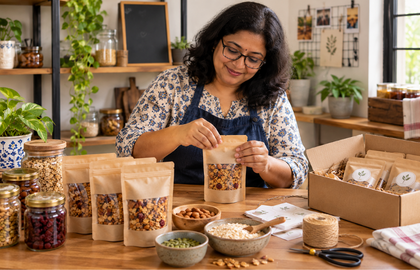
A good example here is Sudipta Gupta of For Cookies' Sake! The business name is memorable, but the description still needs search-friendly terms like cookies, gifting, dessert tables, eggless options, city, or custom orders if those apply.
Here's a simple way to find useful keywords:
- Listen to customer questions: Notice the words people use in DMs, calls, and WhatsApp chats. That language is gold.
- Check nearby competitors: Not to copy them, but to spot category terms your audience already recognises.
- Use Google auto-suggest: Start typing your offer and city. Google will show common search patterns.
Then write like a person, not a machine.
Bad version: “We offer premium cookies, best cookies, custom cookies, cookie gifts, gourmet cookies for all cookie lovers.”
Better version: “Custom cookies for gifting, celebrations, and special events in Kolkata.”
That second version still includes useful search language, but it sounds natural. If you want to sharpen this instinct, these essential content writing techniques are helpful for keeping copy readable while still search-aware.
A few practical checks help:
- Use phrases, not stuffing: “Wedding makeup artist in Chennai” is useful once. Repeating it five times is painful.
- Pair category with context: Product plus city, service plus audience, or niche plus use case usually works well.
- Keep your voice intact: Search-friendly doesn't mean bland. It just means clear.
- Read it aloud: If it sounds odd in conversation, rewrite it.
For more on improving discoverability through better wording, 5 effective strategies for women-led businesses to improve search engine ranking adds useful context.
Editable Templates and Real Before After Examples
Blank-page pressure is real. Most founders don't struggle because they lack ideas. They struggle because they're trying to write from scratch while also running orders, calls, invoices, school pickups, and supplier follow-ups.
Steal the structure, not the wording
Use these as starting points and edit them till they sound like your business.
Template for a D2C product brand
“We create [product] for [customer] who want [benefit]. Based in [city], our products are known for [differentiator]. Shop online / message us for orders.”
Template for a service provider
“I help [customer type] with [service] so they can [practical outcome]. I'm based in [city/online] and specialise in [niche or format]. Book a consultation / enquire for details.”
Template for a coach or consultant
“I work with [specific audience] who want help with [problem]. My approach focuses on [method or philosophy] with support through [format]. Message to book a discovery call.”
Template for a home-based food business
“We make [product type] for [occasion/customer]. Orders available in [city/area], with [customisation or speciality] options. WhatsApp for menu and availability.”

Now let's look at what changes in a before-and-after rewrite.
Before “We are a comprehensive lifestyle brand dedicated to supporting clients through thoughtfully curated experiences and premium offerings.”
After
“We create personalised gift hampers for weddings, festive occasions, and corporate gifting in Delhi. Each hamper is customised to the event, budget, and recipient.”
The first version sounds polished but empty. The second tells you the product, use case, location, and what makes the service practical.
Another one.
Before
“I help women transform their lives and become their best selves.”
After
“I'm a neuro-somatic coach for women navigating stress, burnout, and identity shifts. Sessions are designed for practical emotional regulation and sustainable change.”
That second version sounds more grounded because it names the audience and the actual work. A founder like Madhurima Saigal benefits from that kind of specificity. So does Ritu Bakshi when positioning a leadership practice, or Meenakshi Sharma when describing consulting and learning services.
You can also study effective company presentation models if you want more examples of how businesses structure concise introductions across formats.
A few edits usually make the biggest difference:
- Replace abstract verbs: Swap “transform,” “curate,” and other abstract verbs for what you do.
- Name the use case: Wedding orders, daily wear, tax filing, sleep coaching, kids' workshops. Relevance stems from this.
- Add a real-world marker: Location, format, certifications, niche, or process.
- Write like a person speaks: If it sounds like a brochure, trim it.
For more grounded founder inspiration, business success stories can help you see how niche positioning often beats broad messaging.
Common Mistakes That Weaken Your Description
A weak description is rarely ruined by one big error. It usually loses power through small, common habits.
Small writing habits that quietly reduce trust
One major issue is vagueness. This matters even more for service businesses, freelancers, and women-led brands building trust online. 886 million Indians were online in 2024, according to the IAMAI-Kantar Internet in India reporting referenced by Kantar, and people increasingly evaluate businesses through digital touchpoints first. That's why concise proof points like location, specialisation, and years in business matter. They help a stranger decide that you are real and relevant.
The mistakes below show up often:
- Trying to sound corporate: Phrases like “end-to-end solutions” and “client-centric excellence” don't build trust. They create distance.
- Speaking to everyone: “For all your needs” usually means no clear audience.
- Hiding key details: If your city, niche, format, or credentials are missing, people have to work too hard.
- No next step: A description without a CTA stalls momentum.
- Listing features without context: Don't just say “handmade,” “organic,” or “premium.” Explain what the customer is buying.
Specificity feels less glamorous when you write it, but it feels more trustworthy when someone reads it.
Founders in credibility-sensitive categories need this especially badly. If you're a legal consultant, therapist, coach, nutritionist, or financial professional, proof is not bragging. It's reassurance. Someone like Ishita Mehrotra in a legal context needs clear category language and credibility markers. A fashion founder like Anjali Jain needs product clarity and style positioning. Different sectors, same writing rule.
Do a quick self-audit:
- Underline every vague word: If a word could describe ten businesses, tighten it.
- Check for trust signals: Add location, niche, format, or credential where relevant.
- Cut filler first: Remove anything that sounds nice but adds no decision value.
- End with action: Tell people what to do next.
Your Turn Write Your Business Story This Week
A useful business description does three things well. It gives clarity on what you do, focus on who it's for, and credibility on why someone should trust you.
Start with one profile, not all of them
Don't try to rewrite your website, Instagram bio, WhatsApp profile, and marketplace listing all in one sitting. That's how this gets postponed for another month.
Pick one place where people already discover you. Then rewrite that description using the six ingredients from earlier: headline, what, who, why, proof, and CTA.
Here's a simple challenge for this week:
- Choose one platform: Instagram, WhatsApp Business, Google Business Profile, or your directory listing.
- Write one rough version: Don't edit as you go.
- Cut vague words: Remove anything that sounds polished but unclear.
- Add one proof point: City, specialisation, process, or credential.
- Ask one friend to read it: If she can repeat back what you do, it's working.
If you want extra inspiration from other women-led businesses, browse women-led businesses on Women Listed. Seeing how different founders position themselves can make your own wording much easier to sharpen.
Women Listed helps women entrepreneurs get discovered, build credibility, and grow through practical visibility tools. Create your profile on Women Listed to showcase your business, connect with buyers and collaborators, and join a network built specifically for women-led businesses across India.