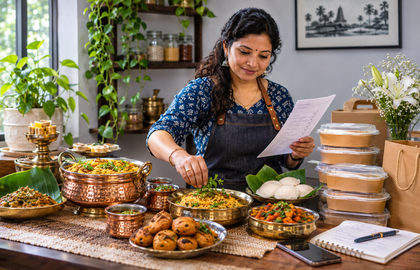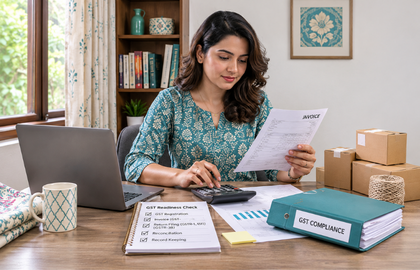
A business no longer has to be built in Delhi, Mumbai or Bengaluru to sell nationally. A Jaipur product founder can ship across India; a Lucknow architect or Mohali professional can work with clients who may never visit her city.
“Tier-2 and Tier-3 India” is not one uniform market, and city-tier definitions vary by dataset. Here the phrase is used as shorthand for entrepreneurship beyond India’s largest metros, while each statistic retains its source’s classification.
The Geography of Entrepreneurship Is Already Changing
Startup India’s 2026 ten-year review reports that 53% of DPIIT-recognized startups are in Tier-2 and Tier-3 cities. It separately reports that 48% of recognized startups have at least one woman director. These figures should not be combined into a made-up statistic about women founders in smaller cities, but they show two parallel shifts: startup activity is spreading geographically, and women are increasingly visible in the recognized-startup ecosystem. See Startup India’s 2026 data.
Women’s entrepreneurship outside metros is broader than recognized startups: it includes home food businesses, professional practices, D2C brands, craft enterprises and local services that may never raise venture capital. The useful question is: what now makes it possible to build beyond the founder’s immediate city?
Digital Demand Has Reduced the Distance to the Customer
A founder no longer needs a metro storefront to reach a metro customer. Marketplaces, digital payments, WhatsApp, online consultations and national logistics have changed the geography of demand.
IBEF, citing Unicommerce, reported that Tier-2 and Tier-3 cities were expected to contribute nearly 66% of new D2C orders in FY26, alongside strong growth in order volumes and GMV. Read the IBEF report. Bain and Flipkart’s 2026 e-retail study similarly found Tier-2+ cities accounted for about 65% of new shoppers and roughly half of incremental orders in 2025.
That matters in both directions: smaller-city founders can reach customers elsewhere, while smaller-city consumers are a growing part of online demand. Digital access, however, does not erase weak economics; shipping, returns and marketplace fees can quickly expose thin margins.
Formalization and Digital Commerce Infrastructure Are Reaching Smaller Businesses
Udyam has made MSME registration online, paperless and free. Formal identity becomes more relevant when a founder needs credit, procurement or a corporate vendor process. Registration does not create demand, but it can make a business easier for formal systems to recognize.
The Ministry of MSME’s current TEAM Initiative goes one step further. Implemented through NSIC and linked to ONDC, it is designed to support micro and small enterprises with onboarding, digital cataloging, account management, logistics and packaging. The program targets 5 lakh MSEs, with 50% intended to be women-owned enterprises, and gives particular attention to Tier-2/3 cities and MSME clusters. Read the official TEAM overview.
Going digital is not only about creating an Instagram page. Catalogue data, fulfillment, packaging and customer management often determine whether wider reach becomes commercially useful.
Entrepreneurship Support Is Becoming More Distributed—and More Responsive
State startup policies, incubators and enterprise-support institutions are no longer concentrated only in the largest metros. Startup India’s national review records startup policies across 32 states and Union Territories, while SIDBI’s MSME Outlook notes that more than half of recognized startups originate from Tier-II and Tier-III cities.
For women, the design of that support matters. A 2026 International Labour Organization case study of the National Institute for MSME found that gender-responsive changes—including more flexible training schedules and childcare and lactation facilities—were followed by a sharp rise in women’s participation in its programs. Read the ILO case study.
A program only helps if women can actually use it. Timing, mobility, care responsibilities and format can determine access.
Local Strengths Can Become National Business Categories
Smaller cities often have assets that do not look like conventional startup infrastructure: craft clusters, regional foods, manufacturing networks, education, healthcare demand, tourism, textiles and deep local professional expertise. Digital distribution can help convert those strengths into larger markets when the offer is clear.
Women Listed’s directory provides small examples of that range. Vidushi Mittal’s Kalaaai in Jaipur describes an e-commerce business working with traditional crafts and luxury home linens. AR Vidhushi Jain of V-Designs & Construction is building an architecture and interior-design practice in Lucknow. Anshpreet Kaur of PEARL Design & Construction is based in Mohali and works across architecture, interiors and design consulting.
These profiles are not city-wide trend data; they simply show the variety of businesses being built beyond the largest metros and why discovery needs to work by category and location.
Trust Still Matters. It Is Just Becoming Hybrid.
Digital channels create reach, but referrals, local business groups, buyer introductions and on-ground showcases still matter. What has changed is what happens after the introduction.
A founder may meet a buyer locally and then send a catalogue, website or Women Listed profile. A customer may hear a recommendation and search the business before making contact. The offline introduction and the online proof reinforce each other.
That is why clear digital information matters even for businesses that still sell through relationships. Women Listed’s Visibility Ladder and AI Search guide both focus on the same foundation: category, location, useful descriptions, current proof and an easy path to enquiry.
The Constraints Are Different From City to City
“Beyond metros” should not become another romantic story. Logistics, specialized talent, local purchasing power, finance, internet quality, childcare, business support and access to large buyers vary significantly from place to place.
Jaipur’s craft and tourism ecosystem is different from Coimbatore’s manufacturing base or Lucknow’s service and cultural economy. A founder needs to know which advantage her location gives the business—and which gap must be solved through digital tools, partners, travel or external suppliers.
The right strategy is rarely “copy a metro startup.” A lower-cost base, local cluster or regional identity may be an advantage, while logistics or talent gaps may require deliberate workarounds.
What Should a Founder Check Before Scaling Beyond Her City?
- Demand: Are customers outside the city already asking for the product or service?
- Economics: After shipping, travel, marketplace fees or customer-acquisition costs, does the margin still work?
- Delivery: Can quality remain consistent when the founder is not personally handling every interaction?
- Trust: Do the website, licenses, reviews, portfolio, specifications and business profiles answer a distant buyer’s questions?
- Support: Which state program, incubator, lender, procurement route or market-access scheme is genuinely relevant?
- Local advantage: What does the current city give the business that would be expensive or difficult to reproduce elsewhere?
Growth does not have to mean relocating. It can mean building a stronger operating base where the business already is and extending the market intelligently.
Frequently Asked Questions
Are most Indian startups now in Tier-2 and Tier-3 cities? Startup India reported in 2026 that 53% of DPIIT-recognized startups were in Tier-2 and Tier-3 cities. That statistic applies to recognized startups, not every MSME, home business or women-owned enterprise in India.
Which sectors are promising for women entrepreneurs outside metros? There is no universal list. Local strengths and customer demand matter more than a generic “best sectors” ranking. D2C products, professional services, food, craft, wellness, architecture and digital services are all visible outside the largest metros, but the business model still has to fit the city and customer.
Does a founder need to move to a metro to scale nationally? Not necessarily. E-commerce, remote service delivery and national logistics can widen market access. The founder still needs workable unit economics, reliable delivery and strong digital proof.
Are there government programs aimed at smaller enterprises outside metros? Yes. One current example is the MSME TEAM Initiative, which supports micro and small enterprises with ONDC onboarding, cataloging, packaging, logistics and account management and gives particular attention to Tier-2/3 cities and clusters.
The Next Business Hub May Simply Be Where the Founder Already Is
Women’s entrepreneurship outside India’s largest metros is the combined effect of digital demand, formalization, distributed support, local strengths and new ways to build trust across distance.
The opportunity is strongest when founders resist copying a metro playbook. Build around the advantage of the local market, formalize when the next stage requires it, make the business discoverable beyond personal networks and use digital channels where the economics make sense. A smaller city does not have to be a limitation; it can be part of the business model.