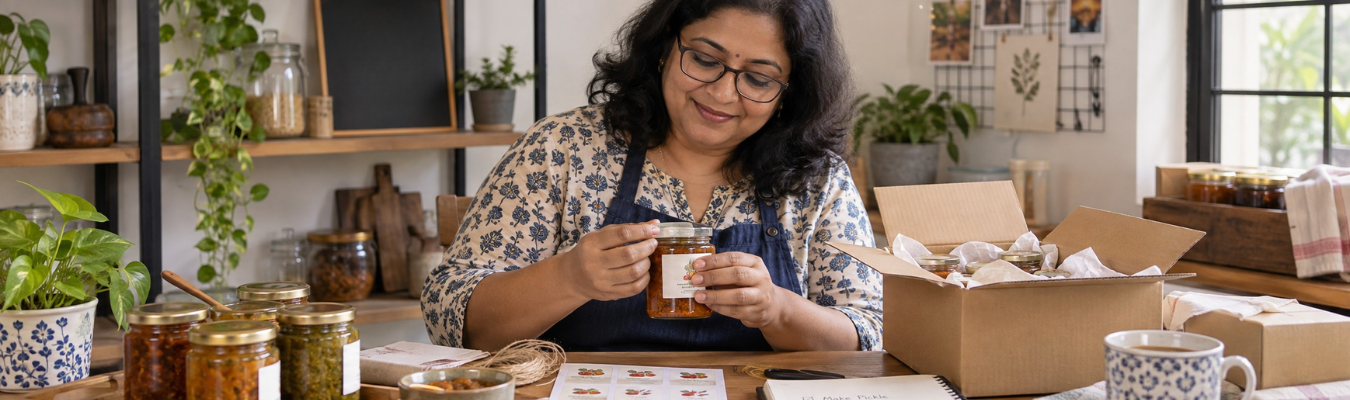
If you make brownies in your home kitchen and sell them through Instagram, are you running a food business in the eyes of FSSAI? Yes. The kitchen being inside a home does not turn commercial food sales into a private activity. What has changed is how small food businesses are regulated. From April 1, 2026, India sharply increased the turnover threshold for basic FSSAI registration and moved licenses and registrations to perpetual validity. That makes the process simpler for many homepreneurs—but it does not remove food-safety, labelling or premises-based responsibilities.
For women entrepreneurs building home bakeries, regional-food brands, snack businesses, cloud kitchens, pickles, preserves or packaged foods, the important question is therefore no longer simply, “Do I need FSSAI?” It is: Which FSSAI category applies to what I actually do?
Does a home food business need FSSAI registration?
Food businesses operating commercially in India fall within the FSSAI licensing and registration framework. The rules cover manufacturing, storage, distribution and sale of food; operating from home does not create a general exemption. This matters even when orders arrive only through WhatsApp, Instagram or personal referrals.
Women Listed's guide to home bakers in Delhi NCR shows how sophisticated the home-baking category has become—from custom celebration cakes to dietary and corporate requirements. That commercial growth makes formal food compliance increasingly relevant.
Basic Registration, State License or Central License: what changed in 2026?
For turnover-based classification, the revised limits effective April 1, 2026 are:
| Annual turnover | Starting category |
| Up to ₹1.5 crore | FSSAI Registration |
| Above ₹1.5 crore and up to ₹50 crore | State License |
| Above ₹50 crore | Central License |
The earlier ₹12 lakh threshold for basic registration is therefore outdated for current 2026 guidance. But turnover should not be used as the only test. FSSAI eligibility also depends on the Kind of Business, activity, production capacity and other criteria for particular food operations. FoSCoS provides an eligibility tool precisely because a food manufacturer, retailer, caterer, dairy unit, importer and warehouse cannot always be classified by one turnover number. A founder should therefore use the turnover limits as the first filter and then confirm the exact category on FoSCoS before applying.
Does each kitchen or premises need a separate FSSAI number?
FSSAI's FoSCoS guidance states that each location is generally issued a separate license or registration. A food and catering business operating units in more than one state must declare a head office and follow the applicable central and premises-level licensing requirements. One premises, however, can have multiple kinds of food business endorsed on its license or registration.
For a homepreneur, this becomes relevant when production moves from one kitchen to a second unit, a central kitchen or a separate warehouse.
What documents should a home food founder prepare?
The exact FoSCoS checklist changes according to the license type and activity. For a straightforward small registration, founders should be ready with their identity, photograph, premises/address and food-business information requested through the application system.
Once the business moves into State or Central licensing—especially manufacturing or processing—the documentation can become more detailed. FoSCoS currently lists items such as a processing-unit layout, equipment and machinery details, food categories to be manufactured, identity/address information and, for relevant manufacturing units, a water-analysis report. The useful principle is: do not download a random checklist from a blog and assume it applies to your kitchen. Select the correct Kind of Business on FoSCoS first and use the documents generated for that activity.
How to apply for FSSAI Registration or License
Step 1: Identify the premises
Start with the state and the exact location from which the food business operates.
Step 2: Select the correct Kind of Business
A home baker manufacturing cakes is not necessarily treated identically to a retailer reselling packaged products or a caterer providing prepared meals.
Step 3: Check eligibility on FoSCoS
Confirm whether the business falls under Registration, State Licence or Central Licence based on current turnover and activity criteria.
Step 4: Complete the application
Enter the business, premises, turnover and food-activity information carefully.
Step 5: Upload the applicable documents
Use the checklist generated for the chosen business type rather than submitting unnecessary documents.
Step 6: Pay the applicable fee
Fees vary by registration/licence category and business activity. FoSCoS remains the correct place to check the live fee applicable to the application.
Step 7: Track the application
Applications can be tracked through FoSCoS using the reference details.
Selling packaged food? FSSAI registration is only the beginning
This is where many small food brands underestimate the work. Receiving an FSSAI number does not automatically make the label on a jar of chutney, granola pouch or box of cookies compliant. India's Food Safety and Standards (Labelling and Display) Regulations, 2020 remain the central labelling framework, with subsequent amendments including one notified in March 2026.
Depending on the product and packaging, mandatory information can include:
- the name of the food;
- ingredients;
- required nutritional information;
- vegetarian/non-vegetarian declaration;
- applicable allergen information;
- manufacturer's or packer's name and address;
- FSSAI logo and licence/registration number;
- net quantity;
- lot, batch or code number;
- manufacturing/packing and applicable date marking;
- storage or use instructions where required.
FSSAI's own guidance identifies these as core pre-packaged food declarations. Other pack declarations—including aspects such as retail price and consumer information—can also arise under Legal Metrology requirements. The practical lesson is that packaging design should go through a compliance review before hundreds or thousands of labels are printed.
A label is also a business document
For a home food brand trying to move beyond neighborhood orders, this is more than regulatory housekeeping. A corporate buyer comparing two food hampers may look for ingredients, allergens, shelf life, FSSAI information and professional packaging before deciding whether a product can enter an employee-gifting program.
That is also why Women Listed initiatives such as The Feast and its food-business discovery content matter most when founders arrive ready not only with good products but with consistent labels, packaging and supply systems.
What happened to FSSAI renewal in 2026?
This is one of the biggest changes founders need to know. Periodic FSSAI renewal has been removed under the revised framework. Registrations and licences now have perpetual validity rather than the earlier one-to-five-year validity periods. So a newly issued compliant registration no longer becomes invalid merely because a founder forgot to renew it after a fixed number of years.
But “perpetual” does not mean the food business can stop complying. The business must continue following the FSS Act and applicable regulations. Changes in premises, activities or other licence particulars may require modification through FoSCoS, and food-safety requirements continue to be enforceable. The government explicitly describes perpetual validity as eliminating periodic renewal while ensuring continued compliance.
When should a home food founder review her FSSAI position again?
Review it when:
- turnover moves into another licensing band;
- production shifts to a new premises;
- another manufacturing unit is opened;
- the business adds a materially different food activity;
- production capacity changes substantially;
- packaged products are introduced;
- the brand begins supplying institutions or larger retailers; or
- a distributor, marketplace or corporate buyer requires additional documentation.
Formalization should move with the business.
Frequently Asked Questions
Can I sell homemade food without FSSAI registration? Commercial food businesses generally fall within the FSSAI licensing or registration framework. Home preparation alone is not a general exemption.
What is the FSSAI Registration turnover limit in 2026? For the revised turnover-based framework effective April 1, 2026, registration extends up to ₹1.5 crore, State licensing up to ₹50 crore and Central licensing applies beyond that level. Activity-specific criteria can still affect the correct category.
Do I have to renew my FSSAI registration every year? No. The revised framework provides perpetual validity and removes periodic renewal.
Does an FSSAI number mean my product is “FSSAI approved”? An FSSAI registration or licence places the food business within the regulatory framework. Founders should avoid presenting it as an endorsement of a product's superiority or healthfulness.
For a home food entrepreneur, FSSAI should not be the paperwork completed after the brand starts growing. It belongs much earlier—alongside recipe consistency, costing, packaging and shelf-life decisions. The 2026 reforms have made entry significantly simpler for small businesses. But easier registration raises the value of getting the next steps right: the correct business category, accurate packaging, clear food information and a production system that can remain compliant as orders grow. That is what turns a home recipe into a business that customers—and larger buyers—can take seriously.