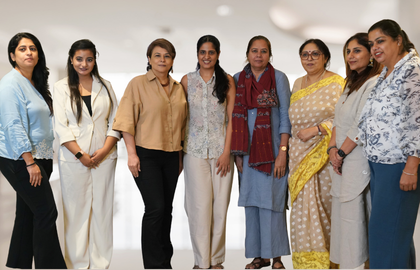
After the birth of her child in 2022, Vibhuti Jain began paying closer attention to something she had previously treated as ordinary: how homes are made to smell “fresh”. Air fresheners, sprays and fragrances were easy to find, but when she started looking for a passive, non-fragranced alternative for everyday spaces, she felt the available charcoal products were largely generic, visually unappealing and difficult to evaluate for performance.
For Vibhuti, a textile designer trained at the National Institute of Design (NID), Ahmedabad, that was as much a design problem as a product problem. She began experimenting with fabrics, activated charcoal and product formats, eventually developing Cocoloop, a line of non-electric activated charcoal air purifier bags under her design business Pigment Lane. Based in Delhi, Cocoloop uses coconut-shell activated charcoal inside textile formats intended for homes, cars, wardrobes, shoes and other enclosed spaces.
Cocoloop is not an electric particulate-air purifier or a substitute for ventilation. Its proposition is more specific: using activated carbon as a passive adsorbent for odors, moisture and certain gaseous pollutants, while offering a reusable alternative to products that add fragrance to a space.
When a Textile Designer Starts With the Material
Vibhuti Jain’s path to Cocoloop did not begin in home wellness. Her Women Listed profile records more than 15 years of experience in textile design, while Cocoloop’s current website details earlier work across product development, material sourcing, print and woven surfaces and sustainable material experimentation. Before Cocoloop, she founded Pigment Lane, a New Delhi textile and design studio; the company also cites previous work with brands including Raw Mango and Ekaya.
That background became unexpectedly relevant when she began researching activated-charcoal products. In her 2026 Women Listed Awards application, Vibhuti described the charcoal bags she encountered in the market as functional objects that were usually meant to be hidden away. Her response was to question both the material construction and the form.
Instead of developing one generic pouch, Cocoloop moved towards use-case-specific products: smaller formats for shoes and helmets, hanging pieces for wardrobes and cars, and more sculptural designs for visible areas of the home. The current collection includes geometric pouches, evil-eye forms, hearts and succulent-inspired pieces priced from around ₹699 to ₹1,499. The result is a product that deliberately sits between sustainable home utility and design-led lifestyle product, rather than competing purely as an inexpensive charcoal bag.
Why the Indoor-Air Question Needed More Than Marketing
The concern that led Vibhuti towards the category is not entirely a branding construct. The US Environmental Protection Agency lists air fresheners among household sources of volatile organic compounds (VOCs), while also noting that some fragranced consumer products can react with other chemicals indoors to form pollutants including formaldehyde. More broadly, many VOC concentrations can be higher indoors than outdoors, although the composition and risk vary substantially by product and compound.
Activated carbon, meanwhile, has a well-established role as an adsorbent. Research on coconut-shell activated carbon has demonstrated adsorption of compounds including formaldehyde and other VOCs under controlled conditions, though actual performance depends on the carbon, modification, airflow, pollutant concentration and testing environment.
That distinction is important for understanding Cocoloop. Rather than making the product valuable simply because it is “natural”, the more credible business question is whether its particular material and construction can demonstrate useful performance.
That became central to how Vibhuti chose to build the brand.
Choosing Proof Before Scale
In her Women Listed Awards application, Vibhuti identifies one decision as particularly consequential: getting independent laboratory testing before trying to scale the product.
“The most consequential decision was getting independent lab certification before scaling—not after,” she says.
Cocoloop currently describes its activated charcoal as scientifically tested for VOC adsorption, odours, smoke smells and dampness. Vibhuti’s Awards submission further reports testing through ITS Noida for formaldehyde and toluene adsorption, alongside a patent application for the production process and a Class 5 trademark. The brand’s website now also highlights certification and testing as part of its product positioning.
For an early-stage consumer business, that decision affected more than product development. It gave Vibhuti a basis for explaining why Cocoloop should not compete solely on price against generic charcoal pouches. It also gave the company material for demonstrations, customer education and B2B conversations.
This is where her founder story becomes more useful than a straightforward sustainability narrative. Cocoloop was entering a category where customers could easily find cheaper substitutes online. Vibhuti’s answer was not simply more attractive packaging; she tried to combine material proof, differentiated construction and design into the value proposition.
Designing a Product People Would Leave in Sight
The design element matters because many household utility products face a simple problem: if customers find them unattractive, they hide them, forget them or stop using them.
Cocoloop has turned that constraint into part of its product strategy. Its charcoal is enclosed in breathable textile forms that can sit on a desk, hang inside a wardrobe or remain visible in a living space. Users are instructed to recharge the product periodically in sunlight, and the brand states that it can be reused for up to two years.
The approach also reflects continuity with Pigment Lane rather than a complete departure from Vibhuti’s earlier career. Textile knowledge remains part of the product: fabric construction affects airflow, while colour, pattern and form determine whether the object feels at home in the environment where it is supposed to work.
For product founders, there is a useful business lesson here. Functional differentiation and aesthetic differentiation do not always need to compete. In categories where products are physically present in a customer’s home every day, design can influence whether the functionality is actually used.
Testing the Market Across More Than One Channel
Cocoloop is still an early-stage business. Vibhuti’s July 2026 Women Listed Awards application describes it as bootstrapped and profitable, with a small team and pan-India sales. She reported approximately ₹2.3 lakh in multi-channel revenue, with Amazon accounting for the largest share and additional business coming from B2B orders and offline events.
The absolute number is modest, but the channel mix is more informative at this stage. Cocoloop has tested consumer demand through e-commerce, exhibited offline and completed B2B gifting work, while developing a five-SKU range across residential and use-case-specific formats. Vibhuti also reported strong Amazon ratings and repeat purchases as early customer-validation signals.
On 25 July 2026, Cocoloop received recognition at the Women Listed The Excellence Awards 5th Edition at India Habitat Centre, New Delhi, as an Emerging Women-Led Brand in the Sustainable and Innovative Product category.
The next test is larger: whether an early product that requires customer education can move beyond founder-led explanation and become a category people understand quickly enough to buy repeatedly.
Building a Sustainable Home Brand Around Behaviour Change
Vibhuti’s three-year plans shared with Women Listed include expanding Cocoloop across e-commerce and B2B channels such as hospitality, healthcare and educational spaces, while eventually exploring markets including the UAE and USA.
But her more interesting ambition is behavioral. Cocoloop is effectively asking customers to reconsider the assumption that a fresh-smelling room is necessarily a cleaner one, and to distinguish adding fragrance from adsorbing unwanted compounds and odors.
That makes education part of the company’s growth challenge. The brand has to explain activated charcoal without overstating what a passive purifier can do, communicate why its construction differs from inexpensive alternatives and make sustainability feel like a practical benefit rather than an abstract virtue.
Vibhuti’s design career gave her the skills to rethink the object. Building Cocoloop is requiring something different: proving the product, creating a category language customers understand and deciding what evidence is strong enough to justify a premium.
For women entrepreneurs building physical consumer products, that progression is worth studying. A personal problem can identify an opportunity, and design can make the solution distinctive. But when the category depends on performance, credibility cannot come from aesthetics or founder storytelling alone.
Discover Vibhuti Jain, Pigment Lane and Cocoloop on Women Listed.
Cocoloop is still early in that journey. What makes Vibhuti’s founder story interesting is that she chose to treat proof as part of the product itself — and is now testing whether science, design and sustainability can together turn a familiar material into a recognizable Indian home brand.