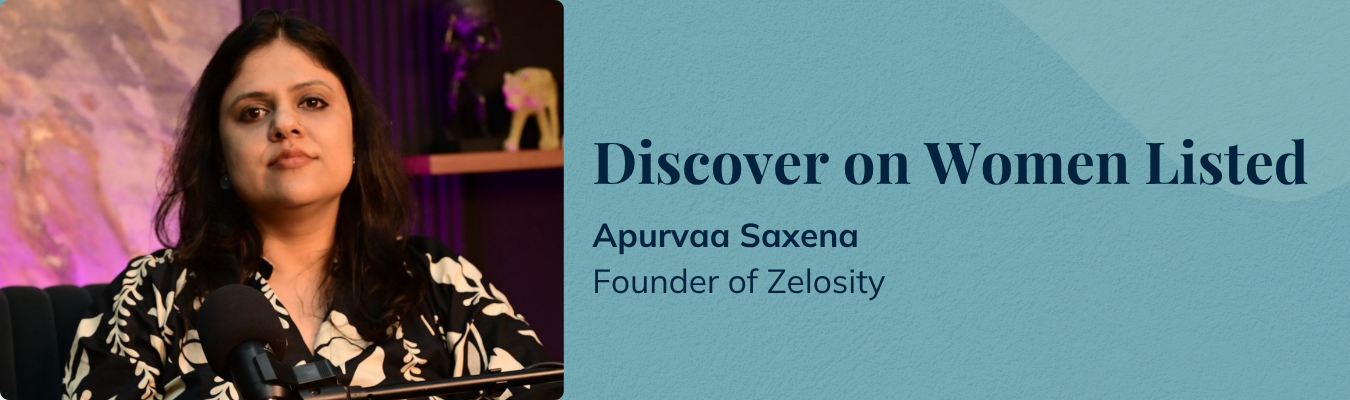
The first version of Apurva Saxena’s business fit inside a small room. She was teaching yoga and fitness under the name Fitness Groovee, building a profession she had entered without a business background. Over time, the practice grew into two centers and expanded beyond conventional yoga classes. Then came 2020, and both centers had to shut.
The closure coincided with an intensely difficult period in Apurva’s personal life. She was dealing with the death of her father, a miscarriage, financial loss and what she describes as severe PTSD and depression. When she eventually returned to offline work, she did not simply reopen the business as it had existed before. She rebuilt it into a wider wellness practice, gradually adding a team, more formats and multiple ways for clients to engage with the brand.
Today, Zelosity operates as a yoga and holistic wellness center in Pitampura, Delhi, with offerings spanning yoga, meditation, teacher training, retreats and complementary wellness practices. The journey from a room where Apurva taught largely through her own time and expertise to a multi-practitioner wellness center is perhaps the more important business story behind the brand.
When Yoga Became the Profession
Entrepreneurship was not an obvious inheritance for this woman entrepreneur. Apurva Saxena grew up in a salaried household, and her mother worked as a senior government official in Parliament and her father was with Indian Oil Corporation. She began her own career in corporate communications at a PR firm. Yoga, however, had been part of her life much earlier.
Apurva describes a serious mental-health episode in 2008 as a turning point and says yoga became an important part of her personal recovery. She began teaching part-time in 2010 and moved into it full-time in 2013. That transition changed yoga from something personally meaningful into the basis of a profession.
She started Fitness Groovee with no experience of running a company and continued expanding her own training as the practice grew. Over the years, she studied additional yoga forms as well as modalities including Reiki, NLP, hypnotherapy and Past Life Regression. In 2018, she renamed and registered the business as Zelosity, reflecting a shift away from positioning it purely as a fitness studio.
Turning Personal Expertise Into a Broader Business
Zelosity today combines multiple forms of yoga with meditation, teacher training, retreats and other wellness experiences. Apurva’s original proposition was straightforward: she wanted to create a place where physical practice and different approaches to emotional wellbeing could be accessed within the same ecosystem.
The business transformation, however, is more significant than the growing service list. Fitness Groovee began largely around Apurva herself—her teaching, her reputation and the number of hours she could personally deliver. Zelosity’s current structure includes a wider team of practitioners working across yoga, meditation and related wellness formats. That gives the business the ability to offer more than one founder can personally teach and makes growth less dependent on Apurva’s individual schedule.
This is an important transition for many expertise-led businesses. Personal credibility may win the first customers, but scaling requires the founder to translate that expertise into an experience that other people can also deliver consistently. For Zelosity, the addition of practitioners, online formats, retreats and corporate work has gradually moved the business in that direction.
Rebuilding Differently After the Pandemic
When both centres closed during the Covid period, Apurva Saxena shifted her work online. She later resumed offline operations from a home-based setup before moving again into a larger wellness space. What emerged was not simply the old studio reopened at a new address.
The rebuilt Zelosity had more flexibility in the way it reached clients. Studio classes continued, but online teaching, retreats, corporate sessions and a wider range of wellness formats meant the business no longer depended on one physical format alone. The disruption had forced Apurva to reconsider what parts of her earlier model still worked and what the next version needed to become.
That is a more useful way to understand resilience in business than simply “starting again”. Rebuilding does not always mean restoring everything that existed before the setback. It can also mean using disruption to identify which parts of the business deserve to return and which need to evolve.
Making the Experience Part of the Offering
Apurva Saxena also brings an experimental instinct to how wellness is experienced at Zelosity. For International Yoga Day, for instance, she created a studio practice accompanied by live guitar and flute. In January 2026, she was quoted by Hindustan Times in a feature on silent-disco yoga, discussing how themed playlists and creative sequencing could help sustain participant interest once the novelty of a new format fades.
For an experience-led business, this kind of experimentation matters because differentiation does not always require inventing another service. It can come from changing how people encounter an existing one—how a class is structured, how participants engage with it and what makes the experience memorable enough to return to.
Apurva says word of mouth has remained one of Zelosity’s strongest sources of business alongside Google and social media. She also reports having trained more than 500 yoga teachers and conducted sessions across corporate and public platforms. In a practitioner-led category, credibility tends to accumulate slowly through teaching, referrals, repeat participation and the reputation attached to the work.
Learning to Build Beyond Herself
One of Apurva Saxena’s more practical founder lessons has been learning not to make personal involvement the measure of commitment. She now delegates responsibilities to her team, protects time for her own exercise and meditation, and deliberately creates space for her daughter and family. She describes self-confidence as a strength and emotional decision-making as an area she continues to work on.
Delegation is particularly consequential in a business like Zelosity because the founder’s personal reputation was initially central to the customer relationship. The current team structure marks a shift from Apurva Saxena teaching wellness towards Zelosity delivering a broader wellness experience. That difference will become increasingly important if the company is to expand beyond one location.
Apurva now plans to move into larger spaces and eventually open additional centers across Delhi NCR. Geographic expansion will therefore test whether the business can carry the same philosophy and customer experience without requiring the founder to be personally present in every interaction.
Building the Next Version
Apurva’s entrepreneurial journey has already moved through several forms: corporate professional, part-time yoga teacher, studio owner, online instructor during a shutdown and then founder of a broader multi-practitioner wellness center. Each stage changed the structure of the work, but not the conviction that first drew her towards it.
Her advice to women entrepreneurs is simple—keep working towards what you want to build even when circumstances make the outcome look unlikely. In her own journey, that idea has had to survive more than one version of the business.
Zelosity was not simply built once and scaled in a straight line. It was built, interrupted and reconsidered before being built again in a different form. For founders whose businesses begin around their own expertise, that may be the more useful lesson: the goal is not only to become better at what you personally do, but eventually to create a business capable of carrying that expertise further than you can on your own.
Discover Apurva Saxena and Zelosity on Women Listed.