A founder in Delhi checks Instagram between vendor calls and sees another award post. A trophy. A winner badge. A smiling team shot from a hotel ballroom. It looks exciting, but also exhausting. Most women running real businesses do not have spare afternoons for long forms, vague eligibility rules, and polished corporate decks.
That hesitation is fair. Awards can waste time when the fit is wrong. They can also become useful business assets when the fit is right. In India, more than 1.84 crore women-owned MSMEs were registered on the Udyam and Udyam Assist platforms as of 2024, representing around 39% of all registered MSMEs, according to the Women's Power Summit & Awards 2026. That is a crowded field, which makes visible credibility matter more, not less.
This guide keeps the focus on practical decisions. Not every founder needs a national media award. Some need community trust. Some need investor-facing recognition. Some need a cleaner way to tell their business story.
The list below breaks down the women entrepreneur awards India 2026 founders should consider, based on business type, application effort, and the kind of visibility each one can realistically bring.
Table of Contents
- 1. Women Listed Excellence Awards
- 2. Express Awards for Women Entrepreneurs
- 3. IMC Ladies' Wing Jankidevi Bajaj Puraskar
- 4. SheThePeople Digital Women Awards
- 5. ET Prime Women Leadership Awards
- 6. TiE Women Global Pitch Competition
- 7. Cartier Women's Initiative
- 2026 Comparison of Top 7 Women Entrepreneur Awards in India
- Your Turn Pick One and Start Your Draft
1. Women Listed Excellence Awards

Some awards feel built for companies with PR teams. This one does not.
The Women Listed Excellence Awards are designed around the kinds of businesses Women Listed sees every day: D2C brands, service businesses, coaches, creatives, food founders, consultants, and home-grown ventures building steadily. That changes the application experience in a very practical way. You are not trying to squeeze your business into a format meant for large corporate leadership profiles.
The strongest part is relevance. A product founder in Jaipur, a consultant in Gurgaon, and a baker in Bengaluru can all apply without having to sound like a venture-backed startup. That matters because a lot of women-led businesses are strong in execution, customer loyalty, and repeat business, but weak only in packaging their story.
Why this one works for small and growing businesses
A Women Listed profile already does part of the heavy lifting. It gives judges and voters a single place to understand your business, see your work, and assess credibility. For founders who hate starting from a blank page, that is useful.
The process is also more accessible than many headline-heavy awards. It is community-facing, transparent, and easier to understand. The trade-off is real, though. This is not the same as winning a newspaper-led national award with broad corporate press coverage. It carries community credibility first.
That can still be commercially valuable. A visible award badge, a feature on the platform, and member recognition often help with conversion when a buyer is comparing similar businesses online. A gifting founder or coach does not always need boardroom prestige. She often needs trust signals.
- Best fit for SMB founders: This is especially strong for businesses that sell through Instagram, WhatsApp, referrals, and local networks, where credibility closes sales faster than polished branding alone.
- Lower application friction: Your profile becomes a base asset, so the work feels cumulative rather than repetitive.
- Useful after the win: A winner badge can be added to your site, Instagram bio links, decks, and proposal PDFs without extra explanation.
- Not built for startup jargon: Founders do not need to force terms like scale narrative or investor readiness if that is not how the business operates.
A founder profile on Women Listed can also support visibility outside the awards cycle. That is the same reason founder-led stories on Women Listed business success stories tend to travel well. Buyers trust specifics.
For example, founders like Bhavika Agarwal of TheGiftHaus, Rakhi Sharma of Tasty Tadka, and Anjali Jain of Eraya reflect the range this kind of award can serve. Their business models are different, but each benefits from visible proof of quality and consistency.
2. Express Awards for Women Entrepreneurs
A media-backed award changes the signal. People outside your immediate customer circle start paying attention.
The Express Awards for Women Entrepreneurs 2026 by The Financial Express and FICCI FLO are better suited to founders who want broad business visibility, not just community recognition. If your business sells into larger partnerships, institutional buyers, or premium segments, a mainstream business-media name can help open doors.
Best for founders who want mainstream business visibility
This route is strongest for founders who already have a clean story and a few clear proof points. Not invented hype. Just a business journey that is easy to understand and relevant beyond your existing audience.
The challenge is predictability. Programmes like this can be jury-led or editorially driven, which means a strong business does not always guarantee a shortlist. Founders should treat it as a brand opportunity, not a dependable pipeline.
- Best for established positioning: If your website, media kit, founder bio, and category story already look coherent, this award can amplify that work.
- Less ideal for very early businesses: A founder still figuring out messaging may find the process frustrating because the judging lens can feel less transparent.
- Helpful for trust with larger partners: Media recognition can support conversations with distributors, collaborators, and corporate buyers.
- Requires better brand packaging: Your business narrative must be clear in a few lines, not hidden inside long explanations.
A founder building in services or consulting can learn a lot from businesses that grow through reputation before scale. Profiles like Deepra Gagneja of Ambrea Image Consultancy and Ritu Bakshi of Aarambh Leadership Institute show how authority-led businesses benefit from visible positioning. Founders who want that next layer of market trust should also spend time on business growth for women entrepreneurs before they apply.
3. IMC Ladies' Wing Jankidevi Bajaj Puraskar

A founder running a city-based D2C brand can waste days on this application and still have no real fit. A founder working with rural artisans, farm-linked production, village women's groups, or handloom clusters has a much stronger case.
The IMC Ladies' Wing Jankidevi Bajaj Puraskar works best for businesses where rural enterprise is central to the model, not added later as a CSR-style layer. That focus is a significant advantage. If your business has been built around rural livelihoods, local production systems, or market access for underserved communities, the award gives you a judging context that general startup awards often miss.
Best for rural and impact-led businesses
This is one of the more strategic awards on this list because the fit is easier to judge upfront. You do not need to guess whether your story sounds impressive enough for a broad jury. You need to show clear founder ownership, real business activity, and credible rural impact.
That changes how you should prepare.
A strong application here usually depends less on polished brand language and more on evidence. Founders should be ready with registration documents, ownership proof, operating details, photos or records of on-ground work, and a clean explanation of who benefits from the business model. If you employ rural women, source from village clusters, or help traditional producers reach larger markets, say that plainly and support it.
- Best fit for rural supply chain businesses: Craft collectives, agri-linked ventures, handloom businesses, producer networks, and village service models usually align well.
- High value for credibility: Recognition from a focused rural award can strengthen conversations with grant partners, institutions, and buyers who care about implementation, not just branding.
- Low fit for urban-first brands: Businesses built mainly around metro customers, content, coaching, or digital reach should apply only if rural enterprise is absolutely core to operations.
- Moderate application effort: The writing is usually simpler than media-heavy awards, but the proof burden is higher. Missing documents can weaken a strong story fast.
A Women Listed profile can help here in a practical way. It gives judges and partners one place to verify the founder, understand the business model, and see the work without chasing scattered links or inconsistent descriptions. That is especially useful for founders whose impact is real but whose online presence is still catching up.
The common mistake is trying to widen the story to sound bigger. Do the opposite. A precise rural business case is usually stronger than a vague “social impact” pitch.
Founders who need to tighten the business side before applying should review business loan options for women. Better financial clarity often improves the application because you can explain scale, sustainability, and founder control with more confidence.
4. SheThePeople Digital Women Awards

Some founders need reach as much as recognition. This is one of the better matches for that goal.
The SheThePeople Digital Women Awards suit businesses that live online. D2C labels, creators, personal brands, community-led businesses, and internet-first service providers usually have a better shot here than businesses that operate through closed networks.
Best for digital-first brands and founder visibility
This format rewards a visible story. If your Instagram, brand voice, customer comments, product photos, and founder journey already tell a consistent story, the award can extend that signal. If your online presence is patchy, the application itself may expose those gaps.
That is not a reason to avoid it. It is a reason to prepare better.
- Best for businesses with public-facing brands: Founders selling beauty, fashion, wellness, food, coaching, or content-led products often fit naturally.
- Editorial storytelling matters: This is not just about what you built. It is about whether your story can travel.
- Visibility can outweigh cash: Media attention, summit exposure, and audience trust can be the true payoff.
- Digital proof should look alive: Stale Instagram pages, broken links, or weak bios can dilute a strong business.
A few Women Listed founders naturally fit this visibility-first model. Sudipta Gupta of For Cookies' Sake!, Vibhuti Jain of Pigment Lane, and Madhurima Saigal all reflect the kind of story-led, digital-facing positioning that tends to perform better in public-facing recognition formats.
Founders who rely heavily on community and city visibility should also pay attention to offline amplification. Awards work better when they sit alongside local presence, events, and founder recall.
5. ET Prime Women Leadership Awards
The ET Prime Women Leadership Awards sit in a different lane from community awards. They speak more directly to enterprise, leadership credibility, and B2B perception.
That does not make them better for everyone. It makes them better for specific founders.
Best for B2B founders and service-led businesses
A consultant, legal advisor, training founder, or category expert often needs authority more than mass consumer visibility. In this context, ET-linked recognition can become useful. It can support conversations with corporate clients, speaking platforms, and larger contracts.
The challenge is fit and timing. These programmes can be heavily curated, and smaller founders can feel invisible if they submit without a strong positioning layer behind them.
- Best for B2B and authority-led brands: Think consulting, legal, leadership training, specialised services, or enterprise solutions.
- Good if your founder role is central: This works better when buyers trust the founder directly, not only the product.
- Harder for under-packaged businesses: If your website still sounds generic, pause and improve that first.
- Worth tracking closely: Timelines and categories may change, so founders need to monitor the official page regularly.
For India-based women entrepreneur award eligibility more broadly, a useful benchmark comes from the Economic Times B2B Entrepreneur Awards category criteria, which require a woman entrepreneur to hold at least 15% equity and to have spent at least two years in a Founder, Co-Founder, or similar role by December 31, 2025. Even when another award uses different rules, this is a smart pre-screening filter.
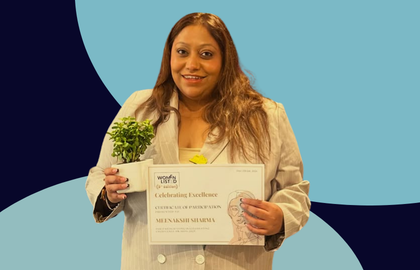
That is especially helpful for founders like Ishita Mehrotra of Areness or Meenakshi Sharma of Learn ABOT Consulting, whose businesses depend on visible expertise and trust.
6. TiE Women Global Pitch Competition

At this stage, many traditional small businesses lose time. Not because the programme is weak, but because the format is very specific.
The TiE Women Global Pitch Competition through India chapters is strongest for founders building startups that can pitch growth, market size, product differentiation, and future scale in a concise way. It is a competition as much as an award.
Best for startup-style businesses that can pitch growth
A founder selling through repeat local orders and referrals may still have a solid business, but that does not automatically translate into a strong pitch competition profile. TiE formats usually reward sharp articulation, investor-style clarity, and comfort with rapid questioning.
The upside is real if the business fits. Mentoring, chapter-level preparation, and exposure can sharpen a founder far beyond the event itself.
- Good for innovation-led ventures: Product, tech-enabled, or process-driven startups tend to perform better than traditional service models.
- High effort required: This is not a one-form submission. It needs deck work, pitch practice, and multiple rounds of attention.
- Valuable even without a win: Jury feedback and chapter mentoring can improve fundraising and business clarity.
- Not the easiest first award: Founders new to public pitching may want one simpler award first.
A pitch competition does not just test the business. It tests how quickly the founder can make the business legible to strangers.
If a founder is still tightening operations, tools matter as much as storytelling. Before applying for a pitch-heavy programme, it helps to review business management tools for women-led businesses and make sure the backend is as clear as the front-end story.
7. Cartier Women's Initiative

This is one of the most ambitious options on the list. It is also one of the easiest to misjudge.
The Cartier Women's Initiative regional awards are built for for-profit women-led ventures with a clear impact story and the ability to explain that impact with discipline. Founders often focus on the prestige first. The better approach is to focus on readiness.
Best for for-profit ventures with a strong impact case
The bar is not just passion. It is structure. You need a venture that can explain what problem it solves, who benefits, why the model is viable, and how impact is tracked.
The same is true in other global programmes. For example, the 2026 Women Entrepreneurs Award by Bayer Foundation and Impact Hub is a six-month accelerator for women founders in health and food security, with applications closing on April 13, 2026, a final cash prize of €25,000, 30 finalists, and 15 awardees selected across regions, according to the Bayer Foundation and Impact Hub programme details. That kind of process shows how global women-focused awards increasingly favour operating ventures with proof, not just promising ideas.
- Best for mission-driven for-profit ventures: Health, food security, inclusion, livelihoods, and similar impact-led models fit better than broad lifestyle businesses.
- Application quality matters a lot: Founders need consistent numbers, clear ownership, and a disciplined business case.
- Huge upside, high selectivity: The programme can be game-changing for the right venture, but it should be treated as a serious project.
- Do not apply too early: If the impact logic is still fuzzy, wait and strengthen it.
A founder preparing for this level of scrutiny should also improve discoverability and narrative consistency across channels. City relevance and business context matter too, especially if the venture is building in active founder hubs. The roundup on women entrepreneurs in Bangalore is a useful example of how place, category, and business story often work together.
2026 Comparison of Top 7 Women Entrepreneur Awards in India
A founder can lose a full week chasing the wrong award. The fastest way to avoid that is to compare them by fit, effort, and payoff before writing a single application draft.
This table is meant to help with that decision. It shows which awards suit different business types, how much work the process usually takes, and what you are likely to get in return. It also helps separate visibility awards from investor-facing competitions and legacy recognitions, because those are very different bets.
| Award | Application effort | What you need to have ready | Likely payoff | Best suited for | Practical edge |
|---|---|---|---|---|---|
| Women Listed Excellence Awards | Low to moderate | Women Listed membership, completed profile, clear business summary, basic proof of activity | Community visibility, credibility, digital recognition, profile discovery | Small businesses, homegrown brands, service founders, coaches, D2C businesses | More accessible for founders who may be overlooked by larger media or investor-led awards. A strong Women Listed profile also supports the application itself. |
| Express Awards for Women Entrepreneurs (The Financial Express & FICCI FLO) | Moderate to high | Strong founder story, business traction, press-ready positioning, category clarity | National media visibility, business credibility, stronger industry access | Established founders who want wider recognition and network reach | Good fit for founders who can present the business clearly in a public, media-facing format |
| IMC Ladies' Wing Jankidevi Bajaj Puraskar (JDBP) | Moderate | Rural impact documentation, operational proof, nomination materials, readiness for formal evaluation | Cash award, citation, long-term trust and recognition | Founders working in rural livelihoods, crafts, agri value chains, handloom, rural services | Strong option for businesses with real grassroots depth, especially where community impact matters more than personal branding |
| SheThePeople Digital Women Awards | Low to moderate | Clear brand story, visible online presence, founder voice, decent application answers | Editorial visibility, event exposure, personal brand growth | Digital-first founders, creators, D2C brands, community-led businesses | Works well for businesses that already communicate well online and can show audience connection |
| ET Prime Women Leadership Awards (ETPWLA), The Economic Times | Moderate to high | Formal submission, business case, leadership narrative, polished positioning | Corporate credibility, leadership recognition, enterprise network value | B2B founders, professional services firms, CXOs, enterprise-facing businesses | Better fit for founders with strong business outcomes and leadership depth than for early consumer brands |
| TiE Women Global Pitch Competition (India → Global) | High | Pitch deck, financials, growth story, investor-ready metrics, time for rounds and mentoring | Investor exposure, mentoring, pitch refinement, global visibility | High-growth startups, especially tech-enabled and fundable ventures | Strong choice if the business is already being built for scale and the founder is ready for scrutiny |
| Cartier Women's Initiative, South Asia & Central Asia | Very high | Detailed impact case, financial model, growth plan, clear social and business outcomes | Grant funding, fellowship, international recognition, alumni network access | For-profit impact ventures with scale potential beyond one market | Worth the effort only if the business can defend both impact and commercial strength under close review |
A few patterns stand out.
Women Listed and SheThePeople are often easier starting points for founders running active businesses without a big awards team behind them. TiE Women and Cartier ask for far more preparation, but they can be worth it for ventures that already have numbers, structure, and scale ambition. ET Prime and Express sit in the middle. They reward clarity, reputation, and a business story that holds up well in public.
The primary trade-off is not prestige versus non-prestige. It is workload versus fit. A rural founder with deep field impact may be far more competitive for JDBP than for a media-led digital award. A D2C founder with a strong public brand may get faster returns from Women Listed or SheThePeople than from a formal leadership award judged like a corporate case.
That is the point of this comparison. Pick the award that matches the business you run now, the evidence you can show now, and the amount of application work you can realistically handle this quarter.
Your Turn Pick One and Start Your Draft
This list can create the wrong kind of pressure. The goal is not to apply everywhere. The goal is to choose one award that matches the business as it exists now, not the business a founder hopes to become six months later.
That one decision cuts the workload quickly. A D2C founder with a strong Instagram presence may be better off preparing for SheThePeople or the Women Listed Excellence Awards than struggling through a startup-style pitch format. A consultant with a founder-led brand may benefit more from ET-linked leadership recognition than from a consumer-facing digital award. A rural founder should not dilute her story by chasing urban relevance when a rural impact award fits better.
The next practical step is simple. Open the application page for one award. Copy the questions into a working document. Then draft short answers for five basics: what the business does, who it serves, what has changed because of the work, why the founder is the right person to lead it, and what makes the business distinct.
Most founders already know these answers. They just haven't written them down cleanly.
A strong application usually depends on three things. First, proof that the business is real and active. Second, a founder story that sounds specific rather than generic. Third, public-facing consistency across website, Instagram, LinkedIn, product pages, and founder profiles. If one channel says premium brand, another says hobby page, and another has no update in months, judges notice.
That is where a visible business profile helps. A Women Listed listing gives founders a practical asset they can keep using across awards, collaborations, referrals, and media opportunities. It creates one place where the business can be understood quickly. That is especially useful for women-led businesses that grow through trust, recommendations, and category reputation rather than flashy fundraising language.
For founders who want to keep building visibility around the application itself, women-led businesses on Women Listed, Business Lounge events, and city-focused discovery like business events in Delhi can all support that wider credibility layer.
Women Listed helps women entrepreneurs across India get discovered, build credibility, and grow through visibility. List your business on Women Listed to showcase your work, connect with buyers and collaborators, and join a network built specifically for women-led businesses.
Women Listed is India's visibility and growth platform for women-led businesses. Explore Women Listed to build your profile, strengthen your credibility for award applications, and get discovered by buyers, collaborators, and media.