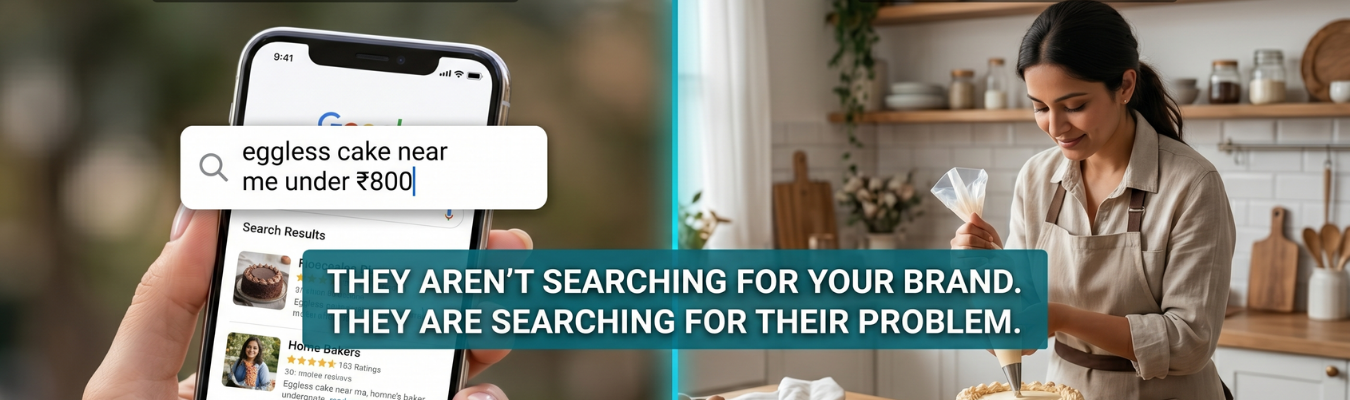
Many entrepreneurs assume the decision happens when a customer messages or places an order. In reality, it begins much earlier — quietly, privately, and through searches. What people type before buying often determines which businesses get noticed, trusted, and shortlisted.
This is true whether they are booking a makeup artist, buying artisanal gifts, choosing a therapist, hiring a marketing agency, or exploring a homegrown skincare brand. Understanding how customers search before they buy is one of the most underused advantages a small or home-based business can have. When you know what your customer is actually typing into that search bar, you can show up at exactly the right moment — before your competitor does.
They’re Not Searching Your Name. They’re Searching Their Problem.
This is the shift that changes everything. When someone needs a home baker for their child’s birthday, they do not search a brand name first. They search “custom birthday cake home baker Delhi” or “eggless cake near me under ₹800.” Discovery starts with the problem, not the brand.
If your online presence only talks about who you are — and not what you solve, for whom, and where — you may stay invisible to the customer who needs you most. Think about what your ideal customer might actually be typing right now:
- Affordable wedding makeup artist Jaipur
- Organic skincare for sensitive skin India
- Nutritionist for PCOS online consultation
- Home-based gifting brand women-led
Quick Fix: Write down five problems your customer has before they find you. Use those phrases naturally in your bio, listing, website copy, and captions.
After They Find You, They Start Fact-Checking You
Once people discover a few options, the next step is rarely an immediate purchase. They want to verify that you are real, reliable, and worth their money. They often look for:
- Reviews and testimonials from real buyers
- Actual photos of your work, not just styled visuals
- Signs that your business is active and recently updated
- Mentions, features, or collaborations
- Clear contact details and business information
Two or three detailed testimonials describing a real experience are often more convincing than ten generic five-star ratings.
Quick Fix: Ask your last three happy customers for a written review or voice note. Make it visible where new customers can easily find it.
Confusion Costs More Opportunities Than Competition Does
You would be surprised how many potential customers quietly exit a page because they could not understand what they needed fast enough. If someone has to search too hard to find out:
- What you offer
- Whether you serve their city
- What your price range looks like
- How to contact you
- What the next step is
…they often move on. Not because they did not want to buy, but because another option felt clearer. A simple, well-structured listing often outperforms a beautiful but confusing page.
Quick Fix: Ask someone unfamiliar with your business to spend 30 seconds on your profile. Can they tell what you sell, who it is for, and how to buy?
They’re Not Looking for the Best. They’re Looking for the Right Fit.
Customers do not always want the best option in general — they want the best fit for their specific situation. That is why searches often include filters like:
- Under ₹2000 or premium
- Near me or last-minute delivery
- For kids or for beginners
- Women-led or sustainable
When you position yourself clearly — for example, wellness coaching for working mothers or handmade candles with same-day delivery in Bangalore — the right customer recognizes you faster. Specificity does not shrink your audience. It attracts people who are already aligned with what you offer.
Quick Fix: Add two or three filters to your business description — who it is for, what makes it different, and what problem it solves best.
Silence Isn’t Disinterest — It’s Research
Many founders assume low inquiries mean low interest. Often, customers are simply researching silently. Someone might visit your profile on Monday, search your name again on Thursday, compare options over the weekend, and message you two weeks later — and that entire journey happened without a single notification on your end.
This is why consistency matters more than virality. When a potential customer returns mid-decision, they should find an active, updated, credible presence — not one that looks abandoned.
Quick Fix: Even one post a week and updated contact information can keep your business presence credible and alive.
The Bottom Line
The customers you want may already be searching. The real question is whether your business is easy enough to find, trust, and understand when they do. Platforms like Women Listed are built to support exactly this — helping small and home-based businesses build a structured, discoverable presence that works even when they are not actively posting.
Because the businesses that get chosen are not always the loudest. They are often the easiest to say yes to.