There's a fundamental difference in how men and women experience entrepreneurship, and we don't talk about it enough.
For most men, the structure is clean. Work hours are work hours. Social time is social time. The boundaries are defined, respected, and rarely questioned. When a man goes to a business event, it's a business event. When he meets friends for dinner, it's dinner. Simple.
For women entrepreneurs, these lines don't exist. And frankly, they never did.
The merge is the method
Think about how most women actually grow their businesses. We sell within our social networks — not through cold outreach, but through relationships we've built over years. We co-learn casually when we meet for lunch or coffee, exchanging strategies between conversations about children and weekend plans. We promote each other through word-of-mouth recommendations that are more powerful than any ad campaign.
Business happens on the go, merged with social and daily life. It's not a side effect of being "unstructured." It's actually a deeply sophisticated, relationship-first model of business building.
Recent academic research supports this. A 2026 study published in Gender, Work & Organisation examining women entrepreneurs in the Global South found that trust-based, informal networks — the kind built over chai and casual meetups — are not incidental but central to how women sustain and grow businesses. These ties, the researchers noted, represent deliberate and strategic adaptations to environments where formal networks remain difficult for women to access.
In India, this reality is even more pronounced. Women entrepreneurs are far more likely to build through informal networks of family and community rather than through formal professional associations. And platforms like WhatsApp groups, Instagram pages, and Facebook communities have become de facto business infrastructure — functioning as storefronts, marketing channels, and support systems all at once.
The conditioning underneath
But the blurred line isn't just about business strategy. It runs deeper.
Women entrepreneurs carry an additional, invisible weight: the conditioning around image and lifestyle. There's the expectation to look a certain way, maintain a certain home, raise children a certain way, show up at family functions, be emotionally available — all while building something from scratch.
Men are rarely asked how they "balance" their work and family. For women, this question is constant, and it carries an implicit judgment: Are you doing enough on both sides?
A 2023 MIT Sloan study found that 68% of female entrepreneurs reported struggling with burnout from this dual burden of business operations and household responsibilities. A 2025 NerdWallet survey found that 35% of women entrepreneurs also work a full-time job, while another 18% do freelance work alongside their business. Only 17% said their business gives them the time flexibility they need.
These aren't just statistics. They describe the daily reality of millions of women running businesses while managing everything else.
Why event formats get confusing
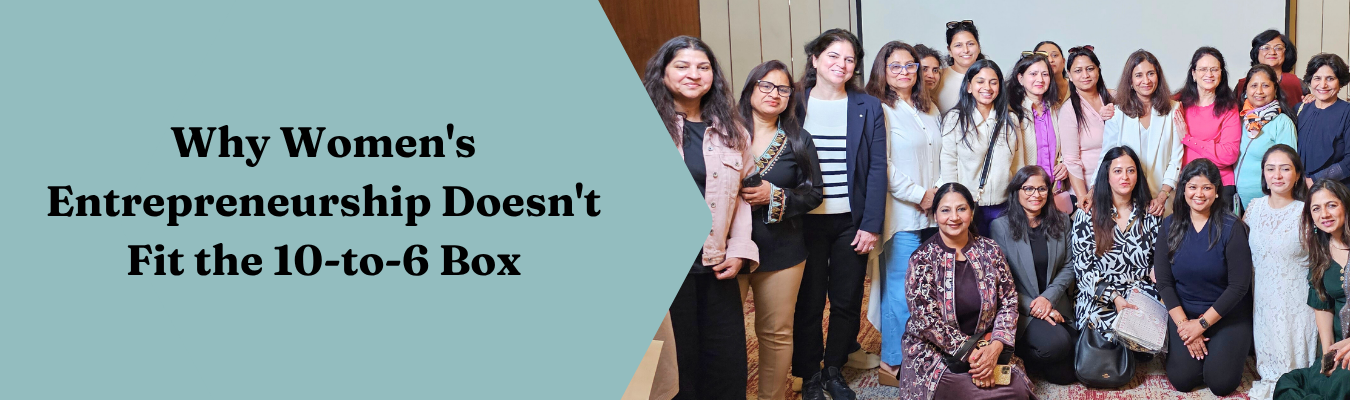
This is exactly why the format of women-centric growth events often feels blurred. When a woman attends a business conference, she's not just there to "network" in the transactional, card-exchanging sense. She's there to build relationships. To find collaborators who might also become friends. To learn something she can apply tomorrow. To sell — not aggressively, but organically, through trust.
The event is simultaneously social, educational, commercial, and emotional. And that's not a design flaw — it's a reflection of how women actually operate.
The challenge is that most business frameworks — including how we design events, measure success, and define "professional growth" — were built around a model where work and life are separate departments. When women show up with their integrated, fluid approach, it can look messy or unfocused to someone measuring against the old blueprint.
But look at the outcomes. Women-focused networking communities built on exactly this blended model — relationship-first, informal, multi-purpose — are thriving. They work because they're designed for how women actually build, not how someone decided they should.
Reframing the narrative
The blurred line is not a weakness. It's a different operating system entirely.
Women don't need to separate their social capital from their business capital — the two are the same thing. The lunch where you swap tips on managing teams IS professional development. The WhatsApp message where you recommend a friend's service IS marketing. The coffee where you vent about a difficult client and walk away with a new perspective IS mentorship.
The world is slowly catching up. More events, communities, and platforms are being designed with this reality in mind — spaces where selling, learning, connecting, and supporting aren't siloed into separate agendas but woven together the way women naturally work.
The question isn't whether women should fit into a structured, compartmentalized model of entrepreneurship. The question is why we ever assumed that model was the only valid one. Women have been building businesses in their own way all along. It's time the ecosystem recognized that and designed for it — not against it.
---
From the Women Listed Founder's Desk — a platform celebrating and supporting the women who build on their own terms.